
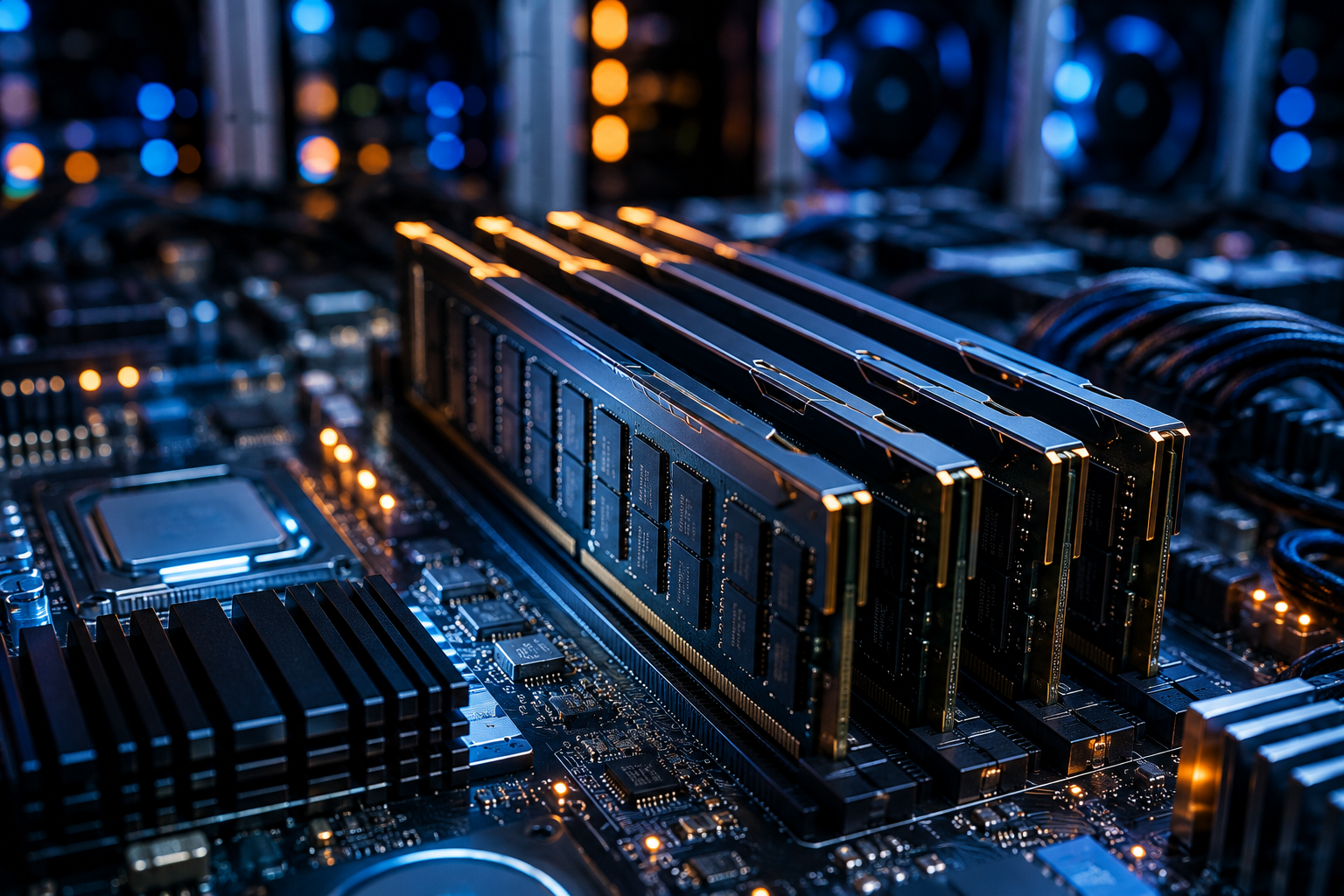
Why AI Is Turning Memory Chips Into One of the Most Strategic Technologies of the Decade
By Ts. Lukas J. Tan
Founder of PDX2026 | CEO of OPERION | AI Educator & Digitalisation Strategist
When people talk about Artificial Intelligence, the conversation usually focuses on AI software, chatbots, image generation, automation tools, or large language models. Most discussions revolve around what AI can do.
Much less attention is given to the technology that makes AI possible.
Behind every AI model, every AI-generated response, and every intelligent application sits a massive infrastructure layer that most people never see. This infrastructure includes advanced semiconductors, data centres, networking systems, power supply, cooling technologies, and perhaps one of the most overlooked components of all — memory.
As AI adoption accelerates globally, memory technologies are quietly becoming one of the most important building blocks of the digital economy.
In many ways, the future of AI may depend just as much on memory as it does on processing power.
Why AI Needs More Memory Than Previous Technologies
Traditional computing systems were designed around relatively predictable workloads.
Personal computers processed documents.
Smartphones handled applications.
Servers supported websites and databases.
While these systems certainly required memory, their demands were relatively manageable compared to modern AI workloads.
Artificial Intelligence operates differently.
Large language models process enormous amounts of information simultaneously. AI systems must access, analyse, store, retrieve, and transfer vast quantities of data at extremely high speeds.
The larger the AI model becomes, the greater the demand for memory.
This is why modern AI infrastructure is not simply a race for faster processors.
It is also a race for faster memory.
Without sufficient memory performance, even the most powerful AI chips cannot operate efficiently.
This reality is changing how the semiconductor industry views memory technologies.
What was once considered a supporting component is now becoming a strategic technology.
The Rise of High Bandwidth Memory (HBM)
One of the most important developments in the AI era is the growing demand for High Bandwidth Memory, commonly known as HBM.
Unlike traditional memory technologies, HBM is specifically designed to transfer large amounts of data at extremely high speeds while maintaining energy efficiency.
This makes it particularly suitable for AI training and inference workloads.
Modern AI accelerators require constant access to vast amounts of information.
Every second, enormous volumes of data move between processors and memory systems.
If the memory cannot keep up, performance suffers.
HBM helps solve this challenge by dramatically increasing data transfer speeds compared to conventional memory solutions.
As a result, HBM has become one of the most critical technologies supporting advanced AI systems.
Today, demand for HBM is being driven by AI servers, hyperscale data centres, cloud computing platforms, autonomous systems, advanced analytics, and next-generation industrial applications.
The AI boom is no longer creating demand only for GPUs.
It is creating demand for the entire memory ecosystem.
Why Memory Remains One of the Most Cyclical Industries in the World
Despite today’s optimism surrounding AI, the memory industry has always been known for its volatility.
For decades, memory markets have followed a familiar pattern.
Demand increases.
Manufacturers expand production.
Supply eventually exceeds demand.
Prices decline.
Investment slows.
The market contracts.
Then the cycle begins again.
This pattern has repeated itself multiple times across both DRAM and NAND markets.
The semiconductor industry often experiences periods of extraordinary growth followed by significant corrections.
This is why experienced industry observers remain cautious even during periods of strong expansion.
History consistently reminds us that semiconductor growth is rarely linear.
Boom periods often create the conditions for future downturns.
At the same time, downturns frequently create the foundation for the next growth cycle.
Understanding this reality is essential for businesses, investors, policymakers, and professionals involved in the technology sector.
What Makes The AI Cycle Different
While memory cycles are not new, many industry observers believe the current AI-driven cycle differs from previous demand waves.
Historically, memory demand was largely driven by personal computers, smartphones, consumer electronics, and enterprise systems.
Today, AI is creating entirely new categories of demand.
Large language models require massive computing clusters.
Data centres continue expanding globally.
Industrial automation systems generate increasing volumes of operational data.
Autonomous technologies rely on real-time processing.
Cloud computing continues growing.
Advanced analytics requires larger datasets.
Unlike consumer technology cycles, AI infrastructure demand is increasingly becoming part of national competitiveness strategies, enterprise transformation initiatives, and long-term digital infrastructure investment plans.
In other words, AI is no longer simply a technology trend.
It is gradually becoming a foundational layer of modern economic activity.
This shift is creating sustained demand for advanced memory technologies across multiple industries simultaneously.
Malaysia’s Growing Role In The AI Memory Ecosystem
What many people may not realise is that Malaysia already plays an important role within the global semiconductor industry.
For decades, the country has been deeply involved in semiconductor manufacturing, assembly, testing, packaging, and advanced electronics production.
As AI infrastructure expands globally, Malaysia’s position within the supply chain is becoming increasingly relevant.
One example is Micron Technology, which has established a significant presence in Malaysia over the years.
Operations in Johor, Prai, and Batu Kawan have become part of the company’s broader global manufacturing network.
These facilities contribute not only to production capacity but also to employment opportunities, engineering development, supplier growth, technical expertise, and ecosystem expansion.
For Penang specifically, the growth of memory-related investments reinforces the state’s broader role within the semiconductor ecosystem.
Penang is no longer simply viewed as a manufacturing location.
Increasingly, it is recognised as part of a larger technology ecosystem supporting the future of AI infrastructure.
Beyond Chips: The Real Economic Impact
When people hear about semiconductors, they often think only about technology products.
However, semiconductor growth creates impacts far beyond the technology sector itself.
Engineering jobs increase.
Supply chains expand.
Industrial services grow.
Automation companies gain opportunities.
Equipment suppliers benefit.
Educational institutions adapt programmes to meet new workforce requirements.
Entrepreneurial opportunities emerge around supporting industries.
This multiplier effect is one reason semiconductor investments attract significant attention from governments worldwide.
The value extends beyond factories.
It influences entire ecosystems.
As AI adoption accelerates, these economic effects may become even more pronounced.
The future workforce will increasingly require digital literacy, technical capabilities, engineering expertise, and adaptability.
Industries connected to AI infrastructure are likely to experience continued transformation over the coming years.
Why Understanding The Semiconductor Cycle Matters
One of the biggest risks during periods of technological excitement is assuming growth will continue indefinitely.
History shows otherwise.
The semiconductor industry has repeatedly experienced cycles of expansion and correction.
Understanding these cycles helps businesses make better decisions.
It helps policymakers plan more effectively.
It helps professionals prepare for industry changes.
And it helps organisations distinguish between short-term hype and long-term structural trends.
AI may be creating one of the strongest demand environments the semiconductor industry has ever experienced.
But even powerful technological shifts operate within economic realities.
Supply, demand, investment, talent availability, infrastructure capacity, and market adoption will continue influencing industry outcomes.
The opportunity remains enormous.
Yet sustainable growth requires long-term thinking rather than short-term excitement.
The Future Of AI Depends On More Than Algorithms
When most people think about AI, they think about software.
But the future of AI depends on far more than algorithms alone.
It depends on semiconductors.
It depends on memory.
It depends on data centres.
It depends on energy infrastructure.
It depends on engineering talent.
And it depends on ecosystems capable of supporting long-term technological development.
This is one reason why conversations surrounding semiconductors, memory technologies, AI infrastructure, and future workforce readiness are becoming increasingly important.
Platforms such as the Penang Digitalisation-AI Conference & Exhibition 2026 (PDX2026) provide opportunities for businesses, professionals, educators, policymakers, and industry leaders to better understand how these forces are reshaping the future economy.
Because the AI revolution is not only being built through software.
It is also being built through the infrastructure that powers it.
And memory may quietly become one of the most important technologies of all.