
Why Penang Is Quietly Becoming Malaysia’s Next AI & Semiconductor Collaboration Gateway
By Ts. Lukas J. Tan
Founder of PDX2026 | CEO of OPERION | AI Educator & Digitalisation Strategist
Malaysia’s AI Future May Depend on Ecosystems, Not Individual Companies
Over the past year, I have spent a considerable amount of time meeting business owners, manufacturers, technology providers, startup founders, educators, engineers, government stakeholders, and industry leaders across different sectors. Regardless of industry, one observation continues to surface repeatedly.
The conversation is changing.
A few years ago, most business discussions focused on sales growth, operational costs, labour shortages, post-pandemic recovery, and market expansion. Today, however, almost every strategic conversation eventually arrives at the same destination.
Artificial Intelligence.
Semiconductors.
Automation.
Digital transformation.
Cybersecurity.
The shift is happening across industries.
Manufacturers are discussing AI-assisted quality control.
SMEs are exploring automation.
Technology companies are developing AI-powered solutions.
Universities are redesigning programmes around future skills.
Government agencies are accelerating digital economy initiatives.
The market is beginning to recognise that the next decade will look very different from the previous one.
The question is no longer whether AI will change industries.
The question is how quickly industries can adapt.
And within that conversation, Penang is beginning to emerge as a particularly interesting case study.
Why Penang Is Appearing More Frequently in AI Conversations
When people think about Artificial Intelligence, many immediately picture Silicon Valley, Shenzhen, Beijing, Singapore, or major global technology companies.
Few people immediately think about Penang.
Yet this may be changing.
Not because Penang suddenly discovered AI.
Not because a single investment transformed the state overnight.
But because the foundations required for the AI economy have already been quietly built over decades.
Long before AI became a mainstream topic, Penang had already established itself as one of Southeast Asia’s most important manufacturing and semiconductor ecosystems.
Engineering talent.
Electronics manufacturing.
Industrial supply chains.
Automation expertise.
Testing and packaging capabilities.
Multinational technology companies.
Supporting SME networks.
Industrial parks.
Technical education pathways.
These capabilities were developed gradually over many years.
Today, as AI accelerates global demand for semiconductors, automation, advanced manufacturing, and industrial digitalisation, these existing foundations are becoming increasingly valuable.
What was once viewed primarily as a manufacturing ecosystem is now becoming strategically relevant to the AI economy.
AI Is Not Just Software
One of the biggest misconceptions about Artificial Intelligence is the belief that AI is purely a software story.
Most people interact with AI through chatbots, content generation platforms, image creation tools, and productivity applications.
However, beneath every AI application exists an enormous infrastructure ecosystem.
AI requires semiconductors.
AI requires data centres.
AI requires networking infrastructure.
AI requires power generation.
AI requires advanced manufacturing.
AI requires highly skilled engineers.
Every large AI model depends on thousands of specialised chips operating continuously inside highly sophisticated infrastructure environments.
This reality is creating new opportunities for regions that already possess strong semiconductor and manufacturing capabilities.
Penang happens to be one of those regions.
As global investments increasingly flow towards AI infrastructure, semiconductor ecosystems become more strategically important than ever before.
This places Penang in a unique position.
Not necessarily as an AI software capital.
But as a critical participant within the broader AI value chain.
The Opportunity Is Bigger Than Penang
I believe one mistake many people make is framing development as a competition between cities or states.
The future opportunity is much larger than that.
Kuala Lumpur remains Malaysia’s most important centre for corporate leadership, investment activity, startup ecosystems, technology companies, venture capital, financial services, and national decision-making.
Penang remains one of Malaysia’s strongest centres for manufacturing execution, engineering capability, semiconductor expertise, and industrial operations.
These strengths are complementary rather than competitive.
In fact, Malaysia’s future competitiveness may depend on how effectively these ecosystems work together.
Technology providers in Kuala Lumpur increasingly need access to real industrial environments where solutions can be tested, validated, and scaled.
Manufacturers in Penang increasingly need technology partners capable of supporting AI implementation, automation strategies, data analytics, cybersecurity readiness, and digital transformation initiatives.
The opportunity exists in the connection between both ecosystems.
When innovation and industrial execution become more closely aligned, the entire country benefits.
Why Many Companies Still Feel Lost
Despite growing excitement surrounding AI, many organisations remain uncertain about their next steps.
Interestingly, the challenge is rarely technology itself.
The challenge is clarity.
Business leaders are facing an overwhelming amount of information.
Every week introduces a new AI platform.
A new automation solution.
A new software vendor.
A new technology prediction.
A new productivity promise.
Many organisations genuinely want to modernise.
They understand the need to evolve.
Yet they struggle with several practical questions.
Which technologies matter most?
Where should investments begin?
How should employees be prepared?
What skills will remain valuable five years from now?
How can digital transformation occur without disrupting daily operations?
These questions are becoming increasingly common across SMEs, manufacturers, service providers, and even large enterprises.
The challenge is no longer awareness.
The challenge is navigation.
The Future Factory Is Becoming Intelligent
The manufacturing industry itself is undergoing a significant transformation.
Historically, factories focused primarily on production output, operational efficiency, labour utilisation, and cost management.
These priorities remain important.
However, modern industrial discussions now include entirely new dimensions.
AI-assisted inspection.
Machine connectivity.
Industrial data visibility.
Digital twins.
Smart dashboards.
Cybersecurity resilience.
Industrial automation.
Real-time analytics.
The factory of the future may not simply be defined by what it produces.
It may increasingly be defined by how intelligently information flows throughout the entire operation.
This shift creates opportunities far beyond traditional manufacturing.
Software developers.
Automation specialists.
AI consultants.
System integrators.
Cybersecurity professionals.
Data analysts.
Industrial educators.
Technology startups.
All become part of the broader industrial ecosystem.
The future industrial economy becomes increasingly interconnected.
Technology Alone Will Not Determine Success
Another reality often overlooked in AI discussions is the human factor.
Technology adoption is important.
But technology alone is not enough.
Employees are concerned about job relevance.
Management teams are under pressure to modernise.
Younger generations are entering the workforce with different expectations.
Cybersecurity threats continue evolving.
Digital scams are becoming more sophisticated.
Information is moving faster than ever before.
In this environment, sustainable transformation requires more than technology deployment.
It requires leadership readiness.
Workforce adaptation.
Organisational clarity.
Continuous learning.
The most successful organisations will likely be those that balance technological advancement with human development.
Because technology may accelerate performance.
But people ultimately determine whether transformation succeeds.
Why Ecosystem Collaboration Matters More Than Ever
The AI era is too complex for organisations to navigate alone.
Manufacturers require technology partners.
Technology companies require industrial use cases.
Universities require industry exposure.
Students require future-ready skills.
Government agencies require ecosystem participation.
SMEs require implementation guidance.
Large corporations require innovation pipelines.
The future economy becomes stronger when these groups interact more effectively.
This is why ecosystem-driven platforms are becoming increasingly important.
Businesses today are no longer looking for exhibitions where visitors collect brochures and leave.
They want practical exposure.
Real implementation examples.
Strategic direction.
Partnership opportunities.
Industry insights.
Meaningful conversations.
Access to decision-makers.
Access to future opportunities.
The demand for ecosystem collaboration is growing because the pace of change is accelerating.
No single organisation possesses all the answers.
Malaysia’s Competitive Advantage May Already Exist
Malaysia already possesses several strengths that many countries would like to have.
A strong manufacturing foundation.
Engineering talent.
Semiconductor experience.
Multilingual capabilities.
Strategic geographic positioning.
Established industrial ecosystems.
Growing digital infrastructure.
Regional connectivity.
The challenge is not whether these assets exist.
The challenge is whether they can be connected effectively.
Future competitiveness may depend less on isolated excellence and more on ecosystem coordination.
The countries that succeed in the AI era may not necessarily be those with the biggest budgets.
They may be the ones that learn faster, collaborate better, and adapt earlier.
Why PDX2026 Matters
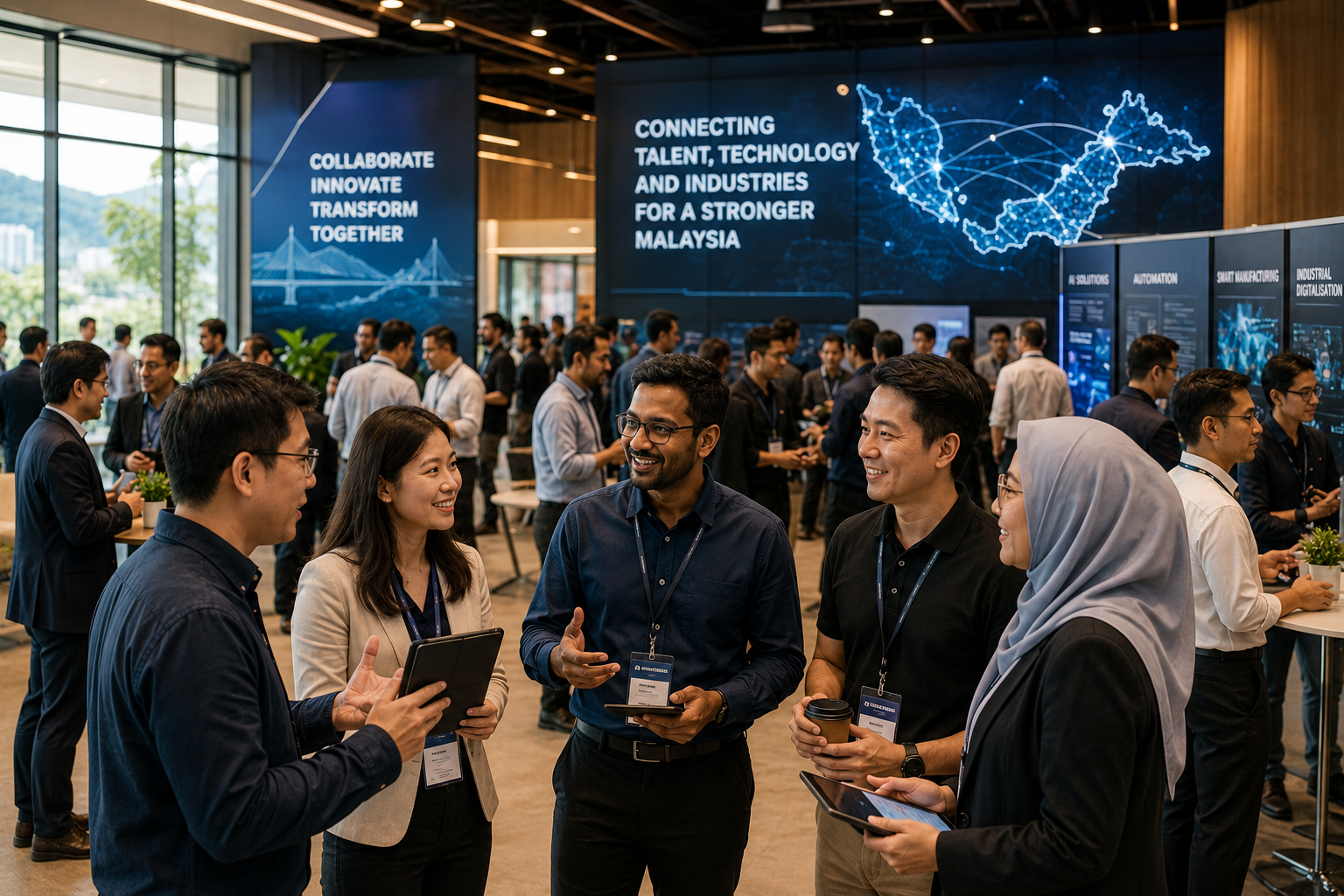
This is one reason why platforms such as the Penang Digitalisation-AI Conference & Exhibition 2026 (PDX2026) are becoming increasingly relevant.
The objective is not merely to organise another conference.
The objective is to create a platform where technology providers, manufacturers, SMEs, government agencies, educators, investors, startup founders, and future industry leaders can engage in meaningful conversations about where the economy is heading.
Because the future will not be built by isolated organisations.
It will be built by connected ecosystems.
And as AI, semiconductors, industrial transformation, workforce readiness, and digital trust become increasingly interconnected, Penang may find itself playing a larger role within Malaysia’s next economic chapter than many people currently realise.
Perhaps the biggest opportunity ahead is not simply AI.
Perhaps it is the ability to bring industries, technologies, talent, and ecosystems together before the next wave of transformation fully arrives.