
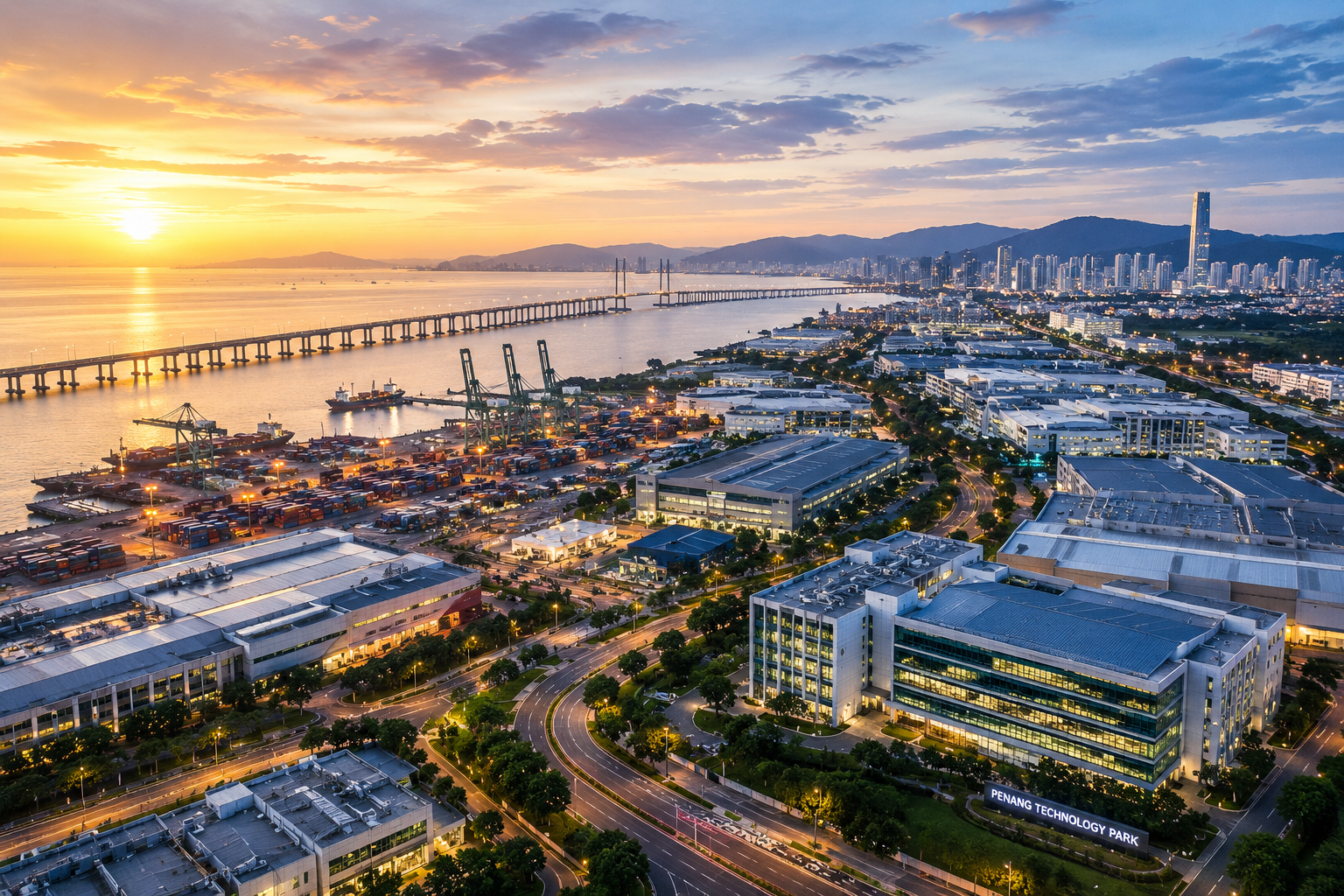
Why Penang’s Semiconductor Success Story Matters More In The AI Era Than Ever Before
By Ts. Lukas J. Tan
Founder of PDX2026 | CEO of OPERION | AI Educator & Digitalisation Strategist
Few People Realise How Close Penang Came To Economic Decline
Today, Penang is often recognised as one of Asia’s most important semiconductor hubs. Global technology companies operate here. Engineers from around the world work here. Semiconductor products linked to Penang eventually find their way into smartphones, servers, vehicles, industrial equipment, medical devices, and increasingly, AI infrastructure.
Yet few people remember that Penang’s story could have turned out very differently.
In 1969, Penang lost its free port status. The decision triggered significant economic challenges. Unemployment increased, investment slowed, and uncertainty spread throughout the local economy. At that point, few would have predicted that the state would eventually become one of the most important locations within the global semiconductor supply chain.
What happened next offers an important lesson not only for Penang, but for any region attempting to remain relevant in a rapidly changing technological world.
The success of Penang was not created overnight.
It was built patiently over decades.
And in the age of Artificial Intelligence, that long-term investment is becoming more valuable than ever.
The Semiconductor Ecosystem Was Built Long Before AI Became Popular
Many people associate today’s semiconductor boom with AI, data centres, and advanced computing. However, Penang’s semiconductor journey began long before AI entered mainstream conversations.
During the 1970s, global technology companies began establishing operations in Penang. Among the earliest and most influential investors was Intel, which helped lay the foundation for what would later become a thriving electronics and semiconductor ecosystem.
Over time, more multinational corporations followed.
AMD.
Bosch.
Micron.
Broadcom.
Renesas.
Keysight.
Lam Research.
And many others.
As these companies expanded their operations, they created demand for engineers, technicians, suppliers, logistics providers, equipment manufacturers, automation specialists, and supporting service industries.
The result was not merely a collection of factories.
It was the gradual creation of a complete industrial ecosystem.
Today, Penang hosts more than 350 multinational corporations alongside thousands of supporting local businesses that collectively form one of Southeast Asia’s most concentrated technology clusters.
This ecosystem represents something far more valuable than physical infrastructure alone.
It represents accumulated knowledge.
And accumulated knowledge is extremely difficult to replicate.
Why Semiconductor Ecosystems Cannot Be Built Quickly
Many governments today are attempting to strengthen their semiconductor industries.
The motivation is understandable.
Semiconductors have become one of the most strategically important industries in the world.
Without chips, there is no AI.
Without chips, there are no smartphones.
Without chips, there are no advanced manufacturing systems.
Without chips, there is no modern digital economy.
As a result, countries across Asia, Europe, and North America are investing billions of dollars into semiconductor development.
However, building semiconductor factories is only one part of the challenge.
Building a semiconductor ecosystem is far more difficult.
Factories can be constructed within a few years.
Talent development often requires decades.
Supply chain relationships require years of trust-building.
Engineering culture develops gradually through experience.
Specialised expertise accumulates over generations.
This is one reason international companies continue investing in Penang despite growing competition from other regions.
The value of Penang extends beyond buildings and machinery.
It lies in the ecosystem itself.
And ecosystems cannot simply be copied.
Understanding Penang’s Current Position In The Global Supply Chain
Despite its success, it is important to understand where Penang currently sits within the semiconductor value chain.
Historically, Penang has been strongest in backend semiconductor activities.
These include assembly.
Testing.
Packaging.
Validation.
Quality assurance.
These processes occur after semiconductor wafers have been manufactured.
Although these activities are critical to the global semiconductor industry, they generally capture less value than certain upstream activities such as chip design and advanced wafer fabrication.
Today, some of the highest-value segments of the semiconductor industry remain concentrated in countries such as the United States, Taiwan, and South Korea.
These countries dominate areas such as:
Advanced chip architecture.
Leading-edge process technology.
High-performance computing design.
Advanced fabrication capability.
Core semiconductor intellectual property.
This creates an important challenge for Penang moving forward.
The question is no longer whether Penang can remain relevant.
The question is whether Penang can move further up the value chain.
Why Moving Up The Value Chain Matters
Economic growth is not determined solely by industrial activity.
It is increasingly influenced by where value is created within the supply chain.
When regions remain concentrated primarily in lower-value segments, wage growth often becomes slower.
Profit margins become more constrained.
Competition from lower-cost countries becomes more intense.
This is why many policymakers, industry leaders, and economic planners are increasingly focused on attracting higher-value semiconductor activities.
These include:
Integrated circuit design.
Advanced packaging innovation.
Artificial Intelligence hardware development.
Semiconductor software tools.
Engineering services.
Advanced manufacturing technologies.
The goal is not to abandon existing strengths.
The goal is to build upon them.
Penang’s backend expertise provides a strong foundation.
The next challenge is leveraging that foundation to participate more deeply in future semiconductor innovation.
AI Is Creating A New Opportunity For Penang
The rise of Artificial Intelligence is creating new opportunities throughout the semiconductor industry.
AI models require enormous computing power.
That computing power requires advanced semiconductors.
Advanced semiconductors require sophisticated manufacturing ecosystems.
This is where Penang’s existing strengths become increasingly important.
Every AI breakthrough ultimately depends on hardware.
Every AI system depends on chips.
Every chip depends on a complex global supply chain.
As demand for AI infrastructure continues growing, regions with strong semiconductor ecosystems become strategically more valuable.
This is one reason why many analysts believe the AI revolution is not only a software revolution.
It is also a semiconductor revolution.
For Penang, this creates opportunities to strengthen its position within the next generation of technology development.
Geopolitical Changes Are Creating New Momentum
Another factor reshaping the semiconductor industry is geopolitics.
The growing technology competition between the United States and China has accelerated efforts to diversify global supply chains.
American companies are increasingly concerned about excessive concentration of manufacturing activities in certain regions.
Chinese companies are simultaneously seeking ways to reduce exposure to geopolitical restrictions.
As a result, many global technology companies are reevaluating where they invest.
In this environment, Malaysia — and particularly Penang — occupies an interesting position.
The state possesses established semiconductor capabilities.
A mature industrial ecosystem.
A skilled workforce.
And a business environment that remains attractive to international investors.
This positions Penang as a potentially important bridge within an increasingly fragmented global technology landscape.
The Semiconductor Industry Remains Cyclical
Despite strong long-term growth prospects, it is important to recognise that the semiconductor industry is not immune to challenges.
Historically, semiconductor markets have experienced repeated cycles.
Periods of strong demand often trigger aggressive expansion.
Expansion leads to increased production capacity.
Eventually, oversupply emerges.
Prices decline.
Orders slow.
Companies reduce costs.
And the cycle begins again.
The industry has experienced multiple boom-and-bust cycles over the past several decades.
This reality means that long-term competitiveness cannot rely solely on favourable market conditions.
Sustainable success requires continuous innovation, talent development, ecosystem strengthening, and strategic positioning.
The regions that survive industry cycles most effectively are often those with the strongest ecosystems.
This remains one of Penang’s greatest advantages.
Why Penang’s Next Chapter Matters
The story of Penang is not merely about semiconductors.
It is about transformation.
A state that once faced significant economic uncertainty gradually reinvented itself through industrial development, talent cultivation, and long-term ecosystem building.
Today, the world is entering another major technological transition.
Artificial Intelligence.
Advanced computing.
Automation.
Smart manufacturing.
Digital infrastructure.
Future workforce development.
All are reshaping the global economy.
The next chapter for Penang may not be defined by how many factories it attracts.
Instead, it may be defined by how successfully it evolves from a world-class assembly and testing hub into a broader centre for semiconductor innovation, AI infrastructure, advanced engineering, and future technology leadership.
This is also why conversations surrounding the Penang Digitalisation-AI Conference & Exhibition 2026 (PDX2026) are becoming increasingly relevant.
PDX2026 is not simply about showcasing technology.
It is about helping organisations understand where the economy is heading, how industries are changing, and what opportunities may emerge from the intersection of AI, semiconductors, digitalisation, and future workforce transformation.
Because in the AI era, competitiveness will not be determined by who reacts fastest.
It will be determined by who prepares earliest.
And Penang’s semiconductor story proves that preparation often begins decades before the world notices the opportunity.