
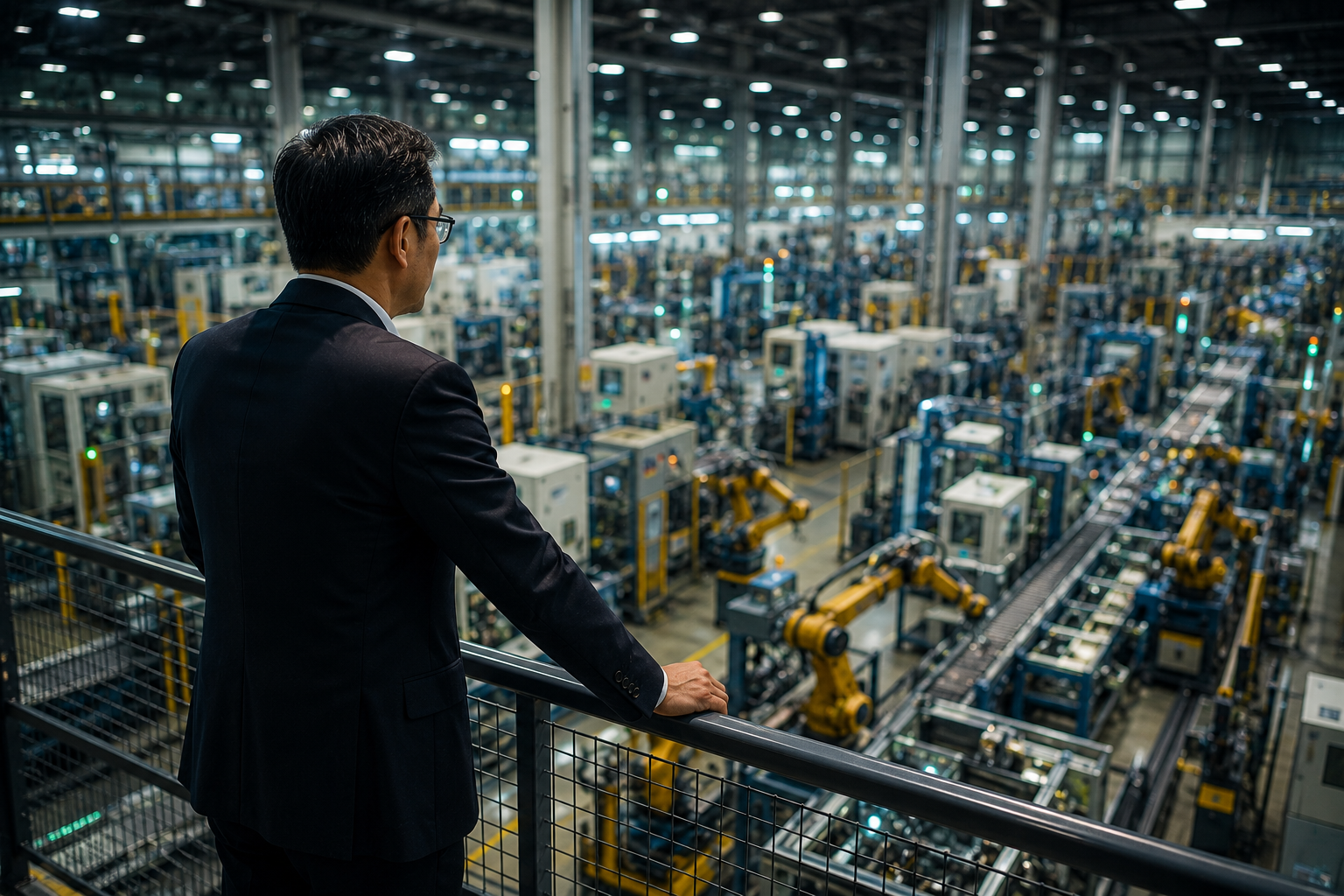
Why The Future Factory Is Not Built By Machines — It Is Built By Decisions
By Ts. Lukas J. Tan
Founder of PDX2026 | CEO of OPERION | AI Educator & Digitalisation Strategist
For many years, when people imagined the factory of the future, the image was always similar.
Rows of autonomous robots moving seamlessly across production floors.
Machines communicating with one another without human intervention.
Artificial Intelligence predicting equipment failures before they happen.
Production schedules adjusting automatically based on customer demand.
Smart dashboards monitoring every aspect of operations in real time.
This vision has become increasingly popular as technologies such as Artificial Intelligence, Industrial Internet of Things (IIoT), automation, robotics, machine learning, and advanced analytics continue to evolve.
Across the world, manufacturers are investing heavily in smart manufacturing initiatives, Industry 4.0 programmes, automation systems, and digital transformation projects.
The assumption is simple.
The more technology a factory adopts, the more advanced it becomes.
Yet after spending years speaking with manufacturers, engineers, technology providers, industrial consultants, and business leaders, I have come to a different conclusion.
The factories that succeed in the future will not necessarily be the factories with the most machines.
They will be the factories led by organisations that consistently make better decisions.
Because while machines create efficiency, decisions create transformation.
The Future Factory Starts Long Before Technology
One of the biggest misconceptions surrounding digital transformation is the belief that transformation begins when technology arrives.
Many organisations still view transformation as a purchasing exercise.
Buy a new ERP system.
Install automation equipment.
Implement AI software.
Deploy sensors.
Upgrade machinery.
Then wait for results.
Unfortunately, transformation rarely works that way.
Technology is often the most visible part of change, but it is rarely the starting point.
The real starting point is leadership.
Every successful digital transformation begins with a decision.
A decision to improve visibility.
A decision to eliminate inefficiencies.
A decision to challenge outdated assumptions.
A decision to prepare for a future that will look very different from the past.
Without these decisions, technology often becomes an expensive tool searching for a purpose.
This is one reason why some manufacturers achieve extraordinary outcomes while others struggle despite investing similar amounts of money.
The difference is rarely the software.
The difference is clarity.
Why Some Smart Factory Projects Fail
Across Malaysia and the wider region, there is growing awareness about smart manufacturing.
Most business leaders understand the importance of automation, AI, industrial data, and digitalisation.
Government agencies actively promote Industry 4.0 adoption.
Technology vendors continue introducing new solutions.
Yet many transformation projects still struggle to achieve their intended results.
Why?
Because technology alone does not solve operational problems.
A factory with disconnected processes remains disconnected even after purchasing new software.
A company with inconsistent data still faces decision-making challenges after implementing dashboards.
An organisation with unclear priorities will remain unclear regardless of how much automation is installed.
Many manufacturers focus on technology before addressing operational maturity.
They invest in automation before standardising workflows.
They implement analytics before ensuring data quality.
They discuss AI before understanding their business processes.
As a result, technology amplifies confusion instead of creating clarity.
The lesson is simple.
Technology is an accelerator.
If the foundation is strong, technology accelerates growth.
If the foundation is weak, technology accelerates problems.
Manufacturing Is Becoming A Decision-Making Business
Historically, manufacturing success was often determined by production efficiency, operational scale, and cost control.
These factors remain important today.
However, modern manufacturing is becoming increasingly dependent on decision quality.
Manufacturers now operate in a far more complex environment.
Supply chains are global.
Customer expectations change rapidly.
Market conditions shift unpredictably.
Geopolitical risks influence sourcing decisions.
AI technologies evolve continuously.
Cybersecurity threats grow more sophisticated.
Workforce expectations continue changing.
Under these conditions, leadership teams are required to make more decisions than ever before.
Which technologies should be prioritised?
Which processes should be automated?
Which investments generate the highest return?
Which skills should employees develop?
Which risks require immediate attention?
These questions cannot be answered by machines alone.
They require judgement.
And judgement remains one of the most valuable competitive advantages in the AI era.
AI Is Changing The Role Of Leadership
Many discussions about AI focus on whether technology will replace jobs.
A more important question may be how AI is changing leadership itself.
AI can analyse information faster than humans.
AI can identify patterns across enormous datasets.
AI can generate recommendations within seconds.
However, AI cannot define organisational priorities.
AI cannot determine corporate values.
AI cannot decide long-term strategic direction.
AI cannot understand human context in the same way experienced leaders can.
As AI becomes more accessible, leadership responsibilities become even more important.
The challenge is no longer access to information.
The challenge is knowing which information matters.
Leaders must distinguish between signal and noise.
They must determine which opportunities deserve attention and which trends should be ignored.
They must balance short-term operational pressures with long-term strategic goals.
In many ways, the AI era is making leadership more important, not less.
Because when everyone has access to similar technology, competitive advantage shifts toward decision quality.
Why Workforce Adaptability Matters More Than Technology
Another common misconception is that the future factory will be entirely automated.
While automation will certainly increase, factories will continue relying on people.
The nature of work may change.
The skills required may evolve.
But human adaptability remains essential.
Employees are increasingly expected to work alongside technology.
Production teams interact with digital systems.
Engineers manage connected environments.
Supervisors analyse operational data.
Managers make decisions supported by AI-generated insights.
As a result, workforce readiness is becoming a strategic issue.
The most successful manufacturers are not only investing in machines.
They are investing in people.
They understand that technology adoption and workforce development must occur together.
A highly adaptable workforce can maximise technology investments.
A workforce that resists change can limit even the most advanced systems.
This is why future competitiveness depends on both digital capability and human capability.
Technology and talent are no longer separate conversations.
They are becoming increasingly interconnected.
The Rise Of Intelligent Manufacturing Ecosystems
Another important shift occurring across the manufacturing sector is the move from isolated factories toward connected ecosystems.
In the past, factories primarily focused on internal optimisation.
Today, competitiveness increasingly depends on ecosystem collaboration.
Manufacturers rely on suppliers.
Suppliers rely on logistics providers.
Technology companies support implementation.
Educational institutions develop talent.
Government agencies create enabling environments.
Industry associations facilitate collaboration.
Success is no longer determined solely by what happens inside a factory.
It is influenced by the strength of the surrounding ecosystem.
This is particularly important for regions such as Penang, where semiconductor companies, automation providers, manufacturers, technology firms, universities, and supporting industries already form a highly interconnected network.
The future belongs not only to smart factories.
It belongs to smart ecosystems.
Why Clarity Is Becoming The Ultimate Competitive Advantage
As AI becomes more affordable and technology becomes more accessible, competitive advantages built purely on technology may become increasingly difficult to sustain.
Most organisations will eventually gain access to similar tools.
Most businesses will eventually adopt some form of AI.
Most manufacturers will continue modernising operations.
The question then becomes:
What separates winners from everyone else?
I believe the answer is clarity.
Clear organisations move faster.
Clear organisations allocate resources more effectively.
Clear organisations adapt more confidently.
Clear organisations make better decisions under uncertainty.
Technology may level the playing field.
Clarity determines who wins the game.
This is why the future factory is not ultimately about machines.
Machines are becoming available to everyone.
What remains scarce is leadership capable of making consistently good decisions.
The Factory Of The Future Is Being Built Today
When people ask what the future factory will look like, the answer often focuses on technology.
AI.
Automation.
Robotics.
Smart sensors.
Connected operations.
All of these technologies will play important roles.
But the most important transformation is happening elsewhere.
It is happening inside leadership teams.
It is happening inside boardrooms.
It is happening through thousands of decisions being made every day.
The future factory does not begin when a robot arrives on the production floor.
It begins when leaders decide to embrace change.
It begins when organisations commit to continuous learning.
It begins when businesses focus on building clarity before complexity.
Technology will continue evolving.
AI will continue advancing.
Machines will continue becoming more intelligent.
But the future will still belong to organisations capable of making better decisions than their competitors.
Because in the end, machines create efficiency.
Decisions create transformation.