
Summary
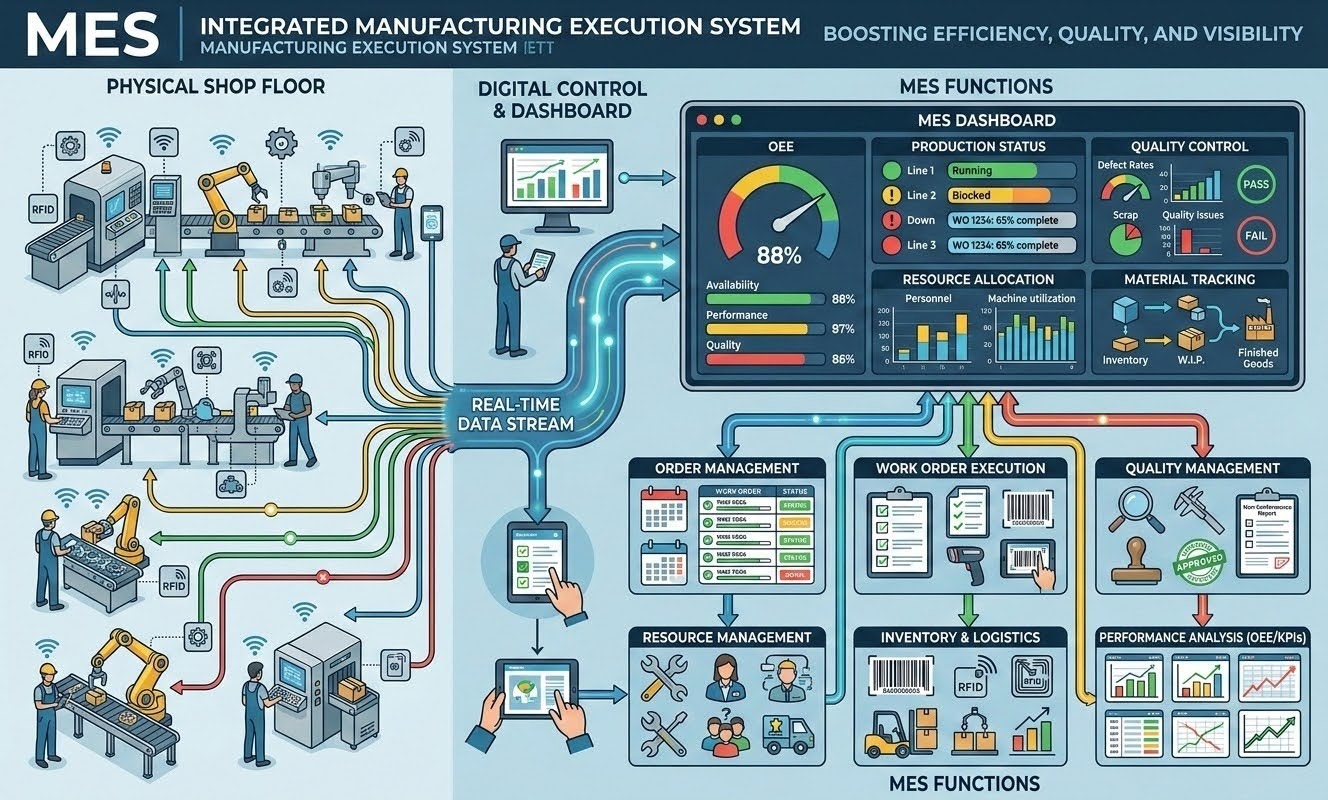
- MES Integration: Manufacturing Execution Systems act as the essential bridge between ERP systems and the shop floor, enabling real-time data flow.
- Industry4WRD Framework: Malaysia’s national policy focuses on three shift factors: people, process, and technology to drive digital transformation.
- ISA-95 Standards: Successful implementation relies on the ISA-95 hierarchy, separating physical processes (Levels 0-1) from business planning (Level 4).
- Funding Status: The Industry4WRD Intervention Fund provides a 70:30 matching grant up to RM500,000, though the Readiness Assessment (RA) program was discontinued as of January 1, 2024.
- Operational Gains: MES eliminates unplanned downtime through predictive maintenance and provides global compliance via end-to-end genealogy tracking.
A Manufacturing Execution System (MES) is the functional layer that connects high-level business planning (ERP) to the real-time work happening on the factory floor. It serves as the “central nervous system” of a smart factory, ensuring that production instructions are executed precisely and data is captured instantly.
In the context of Malaysia’s industrial evolution, MES is no longer optional; it is the primary tool for achieving operational excellence. By digitizing work orders and tracking materials in real-time, manufacturers can eliminate paper-based errors and gain immediate visibility into their production health.
This technology enables a collaborative environment where operators, engineers, and management work from a single source of truth. This alignment is critical for Malaysian manufacturers looking to move up the value chain and compete in the global Industry 4.0 landscape.
Defining Industry 4.0 in the Malaysian Context: The Industry4WRD Framework
Industry 4.0 in Malaysia is defined by the Industry4WRD national policy, which was launched on October 31, 2018, to drive the digital transformation of manufacturing and related services. This framework is built around three core shift factors: people, process, and technology.
Industry 4.0 in Simple Terms: The Convergence of IT and OT
Industry 4.0 represents the convergence of Information Technology (IT) and Operational Technology (OT), where software systems communicate directly with factory machinery. According to MIDA, this transformation is driven by AI, robotics, IoT-connected sensors, and predictive maintenance, framing it as a practical agenda for national competitiveness.
Is Industry 4.0 Happening Now? Current Adoption Rates in Malaysia
Manufacturing is currently prioritized as a new growth engine under the Malaysia Madani Economy framework, emphasizing the importance of digital adoption both within and beyond factory walls. To support this, the government established the Industry4WRD Intervention Fund, a matching grant facility (70:30 basis) providing up to RM500,000 for SMEs to implement digital solutions.
Eliminating Unplanned Downtime: Moving from Reactive Repair to Predictive MES Intelligence
Unplanned downtime is eliminated by using MES intelligence to transition from a “run-to-fail” model to a proactive, data-driven maintenance strategy. By capturing machine data directly, manufacturers can identify issues before they lead to a complete line stoppage.
Real-Time OEE Monitoring: Identifying Hidden Bottlenecks
Overall Equipment Effectiveness (OEE) monitoring allows managers to see the availability, performance, and quality of every machine in real-time. This visibility highlights hidden bottlenecks and micro-stops that are often missed in manual logs, allowing for immediate corrective action.
Predictive Maintenance Integration: The End of ‘Run-to-Fail’
Integrating predictive maintenance into the MES environment ensures that service is performed based on actual machine health rather than arbitrary schedules. This reduces unnecessary maintenance costs and prevents the catastrophic failure of critical components during peak production hours.
Automated Escalation Protocols for Shop Floor Incidents
When a shop floor incident occurs, MES triggers automated escalation protocols that notify the relevant technicians or supervisors via mobile alerts. This ensures that response times are minimized and that every incident is logged for future root-cause analysis.
The Technical Roadmap: A 5-Phase Execution Strategy for MES Implementation
A technical roadmap for MES implementation follows a structured sequence to ensure that data flows seamlessly from the physical hardware to the business office. This approach minimizes risk and ensures that the system is scalable for future growth.
Phase 1: The Readiness Assessment & ISA-95 Alignment
Successful implementation begins with aligning the factory architecture to the ISA-95 standard. ISA-95 Level 0 and Level 1 define the physical production process and the sensing/manipulation layer, providing the foundation for all shop-floor data capture.
Phase 2: Data Acquisition and Edge Connectivity
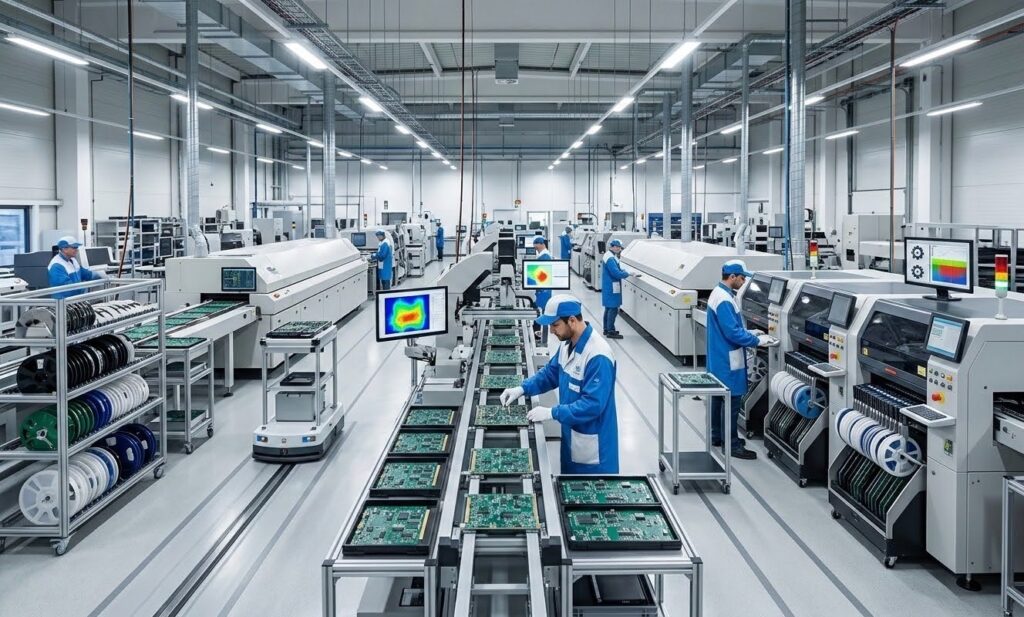
This phase involves connecting sensors and PLCs to Edge Gateways to collect raw data. This step transforms physical signals into digital formats that the MES can process, ensuring high-frequency data is captured without lagging the main network.
Phase 3: Building the Digital Twin of the Production Process
By creating a Digital Twin, the MES models the entire production flow digitally. This allows for real-time simulation and monitoring of the manufacturing environment, where ISA-95 Level 2 (monitoring) and Level 3 (operations management) interact to manage the shop floor.
Phase 4: ERP-MES Integration for Seamless Data Flow
The final technical step connects Level 3 manufacturing operations to Level 4 business planning. This integration ensures that when a sales order is placed in the ERP, it is automatically converted into a production order in the MES.
Achieving End-to-End Traceability: Data Integrity for Global Compliance
End-to-end traceability is the process of tracking every component and process step involved in creating a finished product to ensure total data integrity. This is essential for meeting international quality standards and regulatory requirements in sectors like electronics and medical devices.
Genealogy Tracking: From Raw Materials to Finished Goods
Genealogy tracking provides a complete “birth certificate” for every product, linking raw material batch numbers to specific machines, operators, and timestamps. This level of detail allows manufacturers to prove the exact composition and history of every unit produced.
Digital Quality Gates and Automated Compliance Documentation
MES implements digital quality gates that prevent a product from moving to the next stage of production if it fails a quality check. The system then generates automated compliance documentation, reducing the administrative burden of manual reporting and auditing.
Recall Management: Surgical Precision in Identifying Defective Batches
In the event of a quality issue, MES enables surgical precision in recall management. Instead of recalling an entire month of production, manufacturers can use digital records to identify and isolate only the specific defective batches, significantly reducing financial and reputational damage.
Frequently Asked Questions: Navigating the MES Journey
What is the primary difference between ERP and MES?
While an ERP (Enterprise Resource Planning) system focuses on “why” and “how much” (finance, scheduling, and procurement), the MES focuses on “how” and “when” (execution, machine performance, and real-time quality).
Can MES be implemented in small-scale Malaysian workshops?
Yes, modern modular MES solutions allow small-scale workshops to start with basic modules, such as digital work orders or OEE tracking, and scale up as their digital maturity increases.
Are there government grants for MES implementation in Malaysia?
MITI currently offers the Industry4WRD Intervention Fund, which provides a 70:30 matching grant up to RM500,000 for technology interventions. However, please note that the Industry4WRD Readiness Assessment (RA) program was discontinued effective January 1, 2024, which may impact the traditional application pathway.
Government Grants & Funding Resources
Malaysian manufacturers can leverage various resources to offset the costs of MES adoption. The Industry4WRD Intervention Fund remains a primary resource, offering up to 30% of the matching amount upfront upon approval to assist with initial cash flow.
Beyond direct funding, MITI is developing a database of Industry 4.0 technology and solution providers to help companies find qualified partners for their digital journey. Manufacturers are encouraged to consult the MITI portal for the latest eligibility criteria and available training programs.