
How Penang Helped Build One of the World’s Most Valuable AI Infrastructure Companies
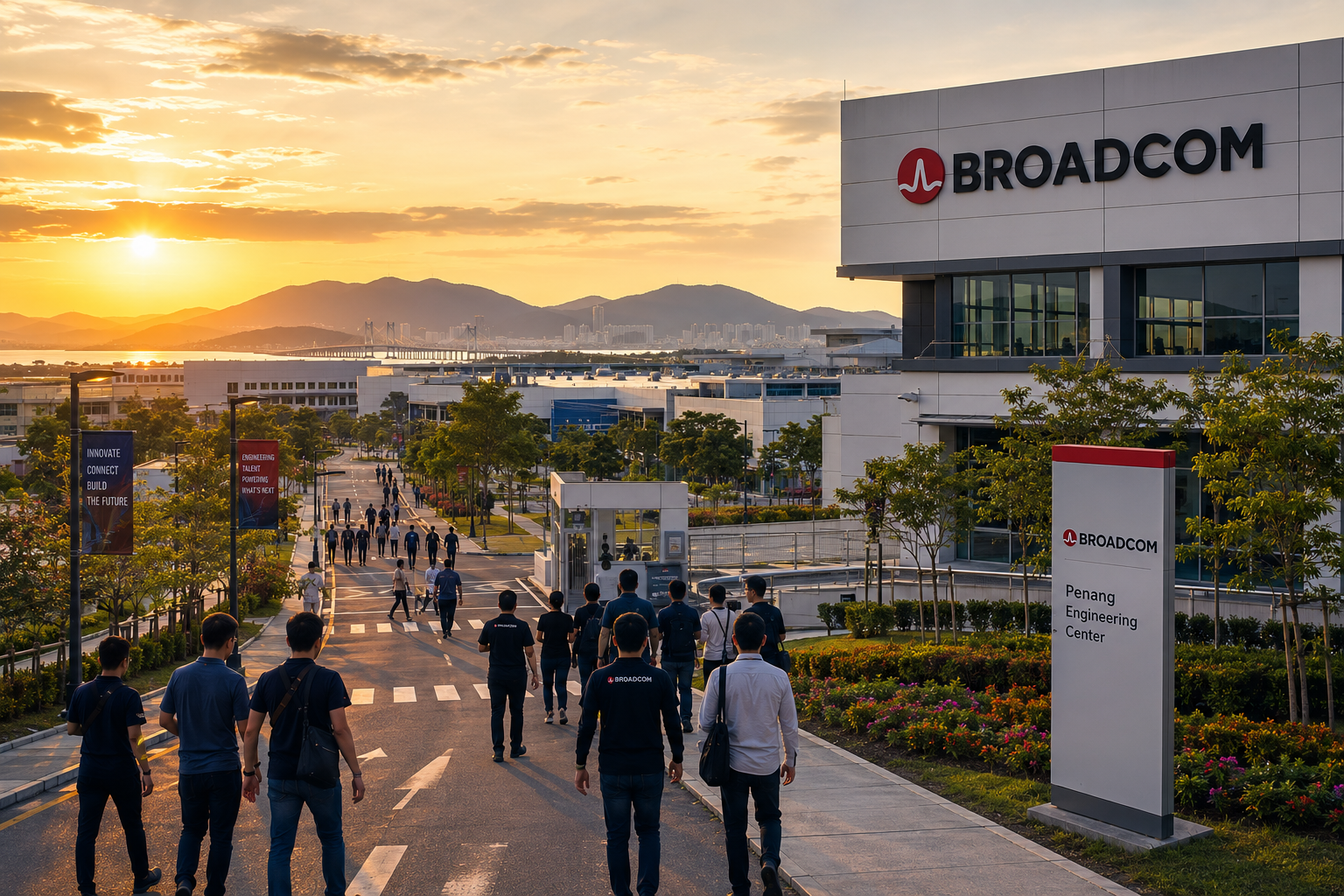
How Penang Helped Build One of the World’s Most Valuable AI Infrastructure Companies
By Ts. Lukas J. Tan
Founder of PDX2026 | CEO of OPERION | AI Educator & Digitalisation Strategist
Executive Summary
When people talk about the Artificial Intelligence revolution, most conversations revolve around software. They discuss AI assistants, large language models, automation tools, and productivity applications. Companies such as OpenAI, Google, Microsoft, and Meta often dominate the headlines.
Yet behind every AI breakthrough lies a less visible reality.
AI runs on infrastructure.
That infrastructure depends on semiconductors.
And among the companies helping power the modern AI economy, few have achieved the scale, profitability, and strategic importance of Broadcom.
Today, Broadcom is one of the largest technology companies in the world. With a market value exceeding two trillion US dollars, it has become one of the most important players in global semiconductor infrastructure, networking technologies, AI data centres, and enterprise connectivity.
What many people may not realise, however, is that part of Broadcom’s story has deep roots in Penang.
For decades, engineers, researchers, technicians, and manufacturing teams in Penang have contributed to the growth of semiconductor companies that eventually became part of Broadcom’s global journey. Long before AI became a global phenomenon, Penang was already helping build the foundations of the technologies that would later support the AI era.
This story is not merely about one company.
It is about how ecosystems are built, how talent compounds over time, and why Penang’s semiconductor future may be far more important than many people realise.
The AI Revolution Is Also a Semiconductor Revolution
Artificial Intelligence is often described as a software revolution.
In reality, it is equally a semiconductor revolution.
Every AI application requires enormous computing power.
Every large language model requires training.
Every AI assistant requires servers.
Every AI data centre requires networking infrastructure.
And every layer of that infrastructure depends on semiconductor technology.
Without semiconductors, there is no AI.
Without advanced chips, there are no large-scale AI systems.
Without networking technologies, AI clusters cannot communicate efficiently.
This reality explains why semiconductor companies have become some of the most valuable businesses in the world.
The market is no longer rewarding only software innovation.
It is increasingly rewarding the infrastructure that makes AI possible.
The Journey From HP to Broadcom
The story of Broadcom is a fascinating example of how technology companies evolve over time.
Its roots can be traced back to 1999 when parts of Hewlett-Packard’s semiconductor operations were separated during the formation of Agilent Technologies.
Over the years, portions of these semiconductor businesses went through multiple corporate restructurings, acquisitions, and ownership transitions.
Eventually, these assets became part of a company known as Avago Technologies.
At the time, many people viewed Avago as a successful semiconductor company, but few could have predicted what would happen next.
In 2016, Avago completed one of the most significant acquisitions in semiconductor history by acquiring Broadcom for approximately US$37 billion.
Rather than continuing under the Avago brand, the combined company adopted the Broadcom name.
That decision marked the beginning of a new chapter.
Today, Broadcom has become one of the world’s most influential technology infrastructure companies.
Its products support:
- AI data centres
- Enterprise networking
- Cloud computing
- Telecommunications
- High-performance computing
- Semiconductor infrastructure
What began as a series of semiconductor businesses eventually became a cornerstone of the global digital economy.
Penang’s Hidden Role in the Story
For many people outside Malaysia, Broadcom is simply a global technology giant.
For many people in Penang, the story feels much closer to home.
Penang has long served as one of Broadcom’s important engineering and operational hubs.
Across different stages of the company’s evolution—from HP to Agilent, from Agilent to Avago, and from Avago to Broadcom—Penang remained an important contributor.
Thousands of engineers, technicians, manufacturing specialists, and operational teams helped support the growth of these organisations over the years.
Many individuals who joined the company simply viewed it as a stable engineering career.
Few could have imagined that the organisation would eventually become one of the world’s most valuable semiconductor companies.
This highlights an important lesson about technology ecosystems.
The future is often built quietly.
People rarely recognise transformational opportunities while they are happening.
Only years later do they realise they were participating in something far larger.
Why Semiconductor Ecosystems Matter
One reason Penang continues to attract global attention is because semiconductor success rarely depends on a single company.
Success depends on ecosystems.
A semiconductor ecosystem includes:
- Manufacturers
- Engineers
- Universities
- Equipment suppliers
- Automation companies
- Research institutions
- Design houses
- Logistics networks
When these components work together, they create a powerful competitive advantage.
This is precisely what Penang has spent decades building.
Unlike newer technology hubs attempting to establish semiconductor capabilities from scratch, Penang benefits from accumulated expertise developed over many years.
Knowledge compounds.
Experience compounds.
Talent compounds.
Industrial ecosystems compound.
These advantages become increasingly valuable as semiconductor technology grows more complex.
Why AI Is Creating a New Opportunity for Penang
Artificial Intelligence is reshaping the semiconductor industry at an unprecedented pace.
Training modern AI models requires:
- Advanced processors
- High-speed networking
- Memory technologies
- Data centre infrastructure
- Energy-efficient systems
As demand for AI increases globally, semiconductor demand rises alongside it.
This trend benefits not only chip designers and manufacturers but also entire ecosystems that support semiconductor development.
Penang is well positioned to benefit from this transformation because it already possesses critical capabilities.
The state has:
- Strong engineering talent
- Global semiconductor companies
- Advanced manufacturing expertise
- Automation technology providers
- Established supply chains
These assets make Penang increasingly relevant in the AI economy.
The future opportunity extends far beyond manufacturing.
It includes design, automation, AI infrastructure, industrial software, smart factories, and advanced engineering services.
The Most Important Asset Is Talent
When discussing semiconductors, many people focus on factories, equipment, and technology.
However, the most valuable asset remains talent.
Every innovation begins with people.
Every breakthrough begins with engineers.
Every technology roadmap begins with human creativity.
The rise of Broadcom demonstrates how engineering talent can create extraordinary long-term value.
Engineers who worked on semiconductor technologies years ago may not have realised that their contributions would eventually support AI systems used around the world.
Yet that is precisely what happened.
This is why talent development remains one of the most important priorities for the future.
As demand grows for:
- AI engineers
- Semiconductor designers
- Automation specialists
- Data centre experts
- Advanced manufacturing professionals
Penang’s ability to develop and retain talent will become a critical competitive advantage.
The Economic Impact Extends Beyond Factories
The success of semiconductor companies creates ripple effects throughout the economy.
Higher-value engineering jobs generate stronger household incomes.
Technology companies create demand for professional services.
Industrial growth supports local businesses.
Innovation encourages entrepreneurship.
The impact extends far beyond the factory floor.
For decades, semiconductors have helped transform Penang from a regional manufacturing location into an internationally recognised technology hub.
The next phase of growth could be even more significant.
As AI continues to expand globally, regions with strong semiconductor ecosystems may experience increased investment, talent attraction, and innovation opportunities.
What Business Leaders Should Learn From Broadcom
Broadcom’s story offers an important lesson.
The companies that ultimately shape industries are not always the most visible during their early years.
Many begin quietly.
They focus on solving difficult problems.
They invest in long-term capabilities.
They build expertise gradually.
Over time, those capabilities compound.
Eventually, they become essential.
This principle applies not only to companies but also to cities, industries, and economies.
Penang’s semiconductor ecosystem was not built in a few years.
It was built through decades of sustained investment, engineering excellence, and ecosystem development.
The same long-term thinking will be required for the AI era.
Frequently Asked Questions
Why is Broadcom important in the AI industry?
Broadcom provides critical semiconductor and networking technologies that support AI data centres, cloud infrastructure, and high-performance computing environments.
What is Broadcom’s connection to Penang?
Penang has long served as an important engineering, manufacturing, and operational hub throughout the company’s evolution from HP to Agilent, Avago, and eventually Broadcom.
Why are semiconductor companies becoming more valuable?
AI, cloud computing, advanced networking, and digital infrastructure all depend on semiconductor technologies, increasing demand across the industry.
What opportunities does AI create for Penang?
AI creates opportunities in semiconductor manufacturing, automation, engineering services, chip design, data centre infrastructure, and future workforce development.
Why is semiconductor talent important?
The future growth of AI and advanced technologies depends heavily on engineers, researchers, designers, and highly skilled technical professionals.
Conclusion: The Future Is Built Long Before People Notice
Looking back, Broadcom’s success may appear inevitable.
In reality, it was the result of decades of engineering effort, strategic decisions, technological evolution, and ecosystem development.
The same can be said for Penang.
The semiconductor ecosystem that exists today was not created overnight.
It was built through generations of engineers, manufacturers, educators, entrepreneurs, and industry leaders who continuously strengthened the state’s capabilities.
Today, the world is entering the AI era.
As AI accelerates demand for semiconductors, networking infrastructure, and advanced technologies, Penang finds itself standing at another important moment in history.
The question is no longer whether semiconductors matter.
The world has already answered that question.
The more important question is whether Penang can continue evolving from a manufacturing hub into a globally recognised centre for semiconductor innovation, AI infrastructure, engineering talent, and future technology leadership.
Because the next generation of world-changing companies may already be operating quietly inside today’s industrial parks.
And just as few people predicted Broadcom’s rise decades ago, the most significant opportunities of the AI era may already be taking shape around us today.
This is also why platforms such as PDX2026 matter. They help connect industry leaders, technology providers, educators, policymakers, and future talent around one critical conversation:
How do we prepare ourselves for the industries that will shape the next decade?