
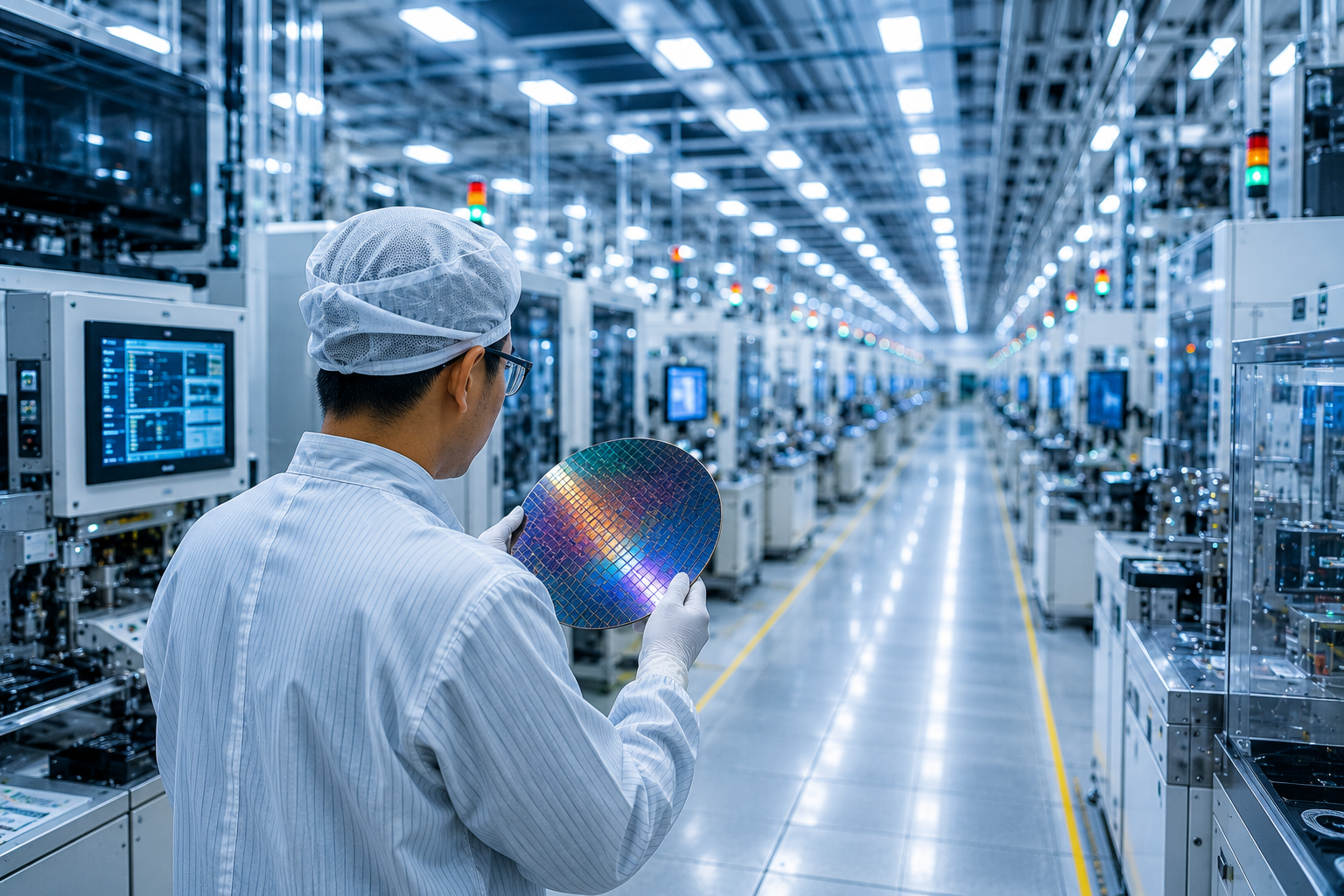
From Factory Jobs to AI Infrastructure: Why Penang’s Semiconductor Legacy Matters More Than Ever
By Ts. Lukas J. Tan
Founder of PDX2026 | CEO of OPERION | AI Educator & Digitalisation Strategist
Executive Summary
For decades, Penang has been recognised as one of Asia’s most important semiconductor and electronics manufacturing hubs. Generations of Penangites grew up hearing a familiar message from parents and elders: study hard, get good results, and one day secure a stable career in one of the many multinational factories located across the state.
At one time, this advice may have sounded ordinary.
Today, however, it carries a completely different significance.
As Artificial Intelligence (AI) transforms the global economy, semiconductors have emerged as one of the most critical resources of the digital era. Every AI model, cloud platform, autonomous system, and intelligent application ultimately depends on semiconductor chips operating behind the scenes.
The AI revolution may appear to be driven by software, but its foundation is built upon hardware.
And few places are better positioned to benefit from this shift than Penang.
This article explores how Penang’s semiconductor legacy has evolved from a manufacturing success story into a strategic advantage for the AI era, why semiconductors are becoming the backbone of global technological competitiveness, and what opportunities lie ahead for Penang’s future economy.
Growing Up in Penang: The Factory Dream
As a Penangite, I grew up hearing a familiar piece of advice.
Study hard.
Get good grades.
Work in a factory.
For many people outside Penang, this advice may seem unusual.
However, for generations of local families, it represented stability, opportunity, and upward mobility.
The “factory” being referred to was never an ordinary factory.
It was the network of multinational semiconductor and electronics companies that helped transform Penang into one of Malaysia’s most successful industrial states.
Companies from the United States, Europe, Japan, and other parts of Asia established operations here, creating thousands of jobs and building a highly skilled workforce.
These companies provided:
- Stable employment
- Competitive salaries
- Technical training
- International exposure
- Career development opportunities
For many families, the semiconductor industry became a pathway toward a better future.
Why Semiconductors Once Felt Less Exciting
Interestingly, there was a period when many young people viewed the software industry as far more exciting than semiconductors.
During the rise of Silicon Valley, names like Google, Microsoft, Facebook, and later startups dominated global technology conversations.
Students dreamed about:
- Software development
- Internet startups
- Mobile applications
- Social media innovation
We frequently heard stories about:
- Attractive office environments
- Flexible working cultures
- High salaries
- Stock options
- Entrepreneurial success
Compared to these stories, semiconductor manufacturing often appeared less glamorous.
The industry operated largely behind the scenes.
Consumers rarely saw the factories.
Most people interacted only with the finished products.
As a result, many underestimated the importance of semiconductor technology.
Today, that perception is changing dramatically.
The AI Revolution Is Actually a Semiconductor Revolution
When people think about Artificial Intelligence, they usually think about applications.
ChatGPT.
AI image generation.
Autonomous vehicles.
Virtual assistants.
AI-powered software.
Yet these applications represent only the visible layer of a much larger technological ecosystem.
Behind every AI interaction lies an enormous amount of computing infrastructure.
AI is not simply a software story.
It is fundamentally a computing story.
And computing depends on semiconductors.
Every AI model requires:
- High-performance processors
- Advanced memory systems
- Data centre infrastructure
- High-speed networking
- Massive storage capacity
Without semiconductor chips, modern AI would not exist.
In many ways, semiconductors have become the “oil” of the digital economy.
Why AI Requires So Much Computing Power
Large AI models require extraordinary computational resources.
Training a modern AI model may involve:
Thousands of GPUs.
Massive data sets.
Months of continuous processing.
Extremely high electricity consumption.
Advanced cooling systems.
The larger the model becomes, the greater the computational demand.
This demand creates a chain reaction throughout the semiconductor ecosystem.
More AI means:
More chips.
More advanced manufacturing.
More memory.
More packaging.
More networking infrastructure.
More energy consumption.
As AI adoption accelerates globally, demand for semiconductor technology continues to grow.
The Semiconductor Industry Has Changed Forever
Historically, semiconductor companies competed primarily on manufacturing process nodes.
The industry focused heavily on:
- 14nm
- 10nm
- 7nm
- 5nm
- 3nm
Each generation delivered greater performance and efficiency.
While competition was intense, technological leadership frequently changed hands.
Companies could catch up.
New competitors could emerge.
Market leadership shifted periodically.
Today, the landscape is different.
Advanced semiconductor manufacturing has become significantly more complex and expensive.
Modern semiconductor leadership now requires expertise in:
- Advanced process technology
- High-bandwidth memory (HBM)
- Chiplet architecture
- Advanced packaging
- AI accelerator design
- Supply chain integration
The barriers to entry have increased dramatically.
As a result, industry leadership is becoming increasingly concentrated among a small group of highly specialised companies.
Why Advanced Packaging Is Becoming a Strategic Battleground
One of the most important shifts occurring within the semiconductor industry is the growing importance of advanced packaging.
For decades, process technology dominated industry discussions.
Today, packaging has become equally critical.
AI chips generate enormous amounts of heat.
They process huge volumes of data.
They require extremely fast communication between components.
Traditional packaging methods are no longer sufficient.
Technologies such as:
- CoWoS
- Chiplets
- 3D Packaging
are becoming critical competitive advantages.
Future AI performance will depend not only on chip design but also on how components are integrated together.
This creates opportunities throughout the semiconductor value chain.
How Penang Became a Semiconductor Powerhouse
Penang’s semiconductor journey began more than five decades ago.
Over time, the state developed a unique industrial ecosystem combining:
Manufacturing expertise.
Engineering talent.
Supply chain integration.
Technical education.
Global connectivity.
This ecosystem attracted some of the world’s leading technology companies.
As investments increased, supporting industries emerged.
Local suppliers expanded.
Engineering talent grew.
Knowledge transfer accelerated.
The result was a highly interconnected ecosystem capable of supporting increasingly sophisticated manufacturing activities.
Today, Penang is often referred to as:
“The Silicon Valley of the East.”
This reputation is not based on hype.
It is built upon decades of industrial development.
Why AI Creates a New Opportunity for Penang
The AI boom is creating unprecedented demand for semiconductor technologies.
This creates several strategic opportunities for Penang.
Opportunity 1: Higher-Value Manufacturing
As semiconductor complexity increases, manufacturers require more advanced capabilities.
This allows Penang to move further up the value chain.
Opportunity 2: Talent Development
AI-driven industries require:
- Engineers
- Data specialists
- AI professionals
- Automation experts
- Cybersecurity specialists
This creates new career pathways for future generations.
Opportunity 3: Global Investment
Countries and corporations are actively seeking trusted semiconductor ecosystems.
Penang’s established track record positions it well to attract future investment.
Opportunity 4: Ecosystem Expansion
The AI economy extends beyond chips.
It includes:
- Data centres
- Cloud infrastructure
- Energy systems
- Smart manufacturing
- Digital services
This creates opportunities for SMEs, startups, educators, and technology providers.
Why Semiconductors Matter to Every Business
Many business owners assume semiconductors are relevant only to manufacturers.
This is no longer true.
Modern businesses increasingly depend on technologies powered by semiconductor innovation.
These include:
- AI systems
- Cloud platforms
- Smart devices
- Digital payment systems
- E-commerce infrastructure
- Industrial automation
- Cybersecurity solutions
Whether directly or indirectly, semiconductors influence almost every industry.
Understanding this connection helps businesses prepare for future digital transformation.
Frequently Asked Questions
Why are semiconductors important for AI?
Semiconductors provide the computational power required to train and operate AI systems. Without advanced chips, modern AI applications would not be possible.
Why is Penang famous for semiconductors?
Penang has developed a strong semiconductor ecosystem over more than 50 years, attracting multinational companies, engineering talent, and supporting industries.
What industries benefit from AI-driven semiconductor growth?
Manufacturing, cloud computing, data centres, telecommunications, energy, automation, logistics, and software development all benefit from semiconductor innovation.
Why is advanced packaging important?
Advanced packaging improves chip performance, energy efficiency, and communication speed between components, making it critical for AI applications.
Can SMEs benefit from the semiconductor ecosystem?
Yes. SMEs can participate through manufacturing support, engineering services, software development, automation solutions, training, logistics, and digital transformation initiatives.
Conclusion: Penang’s Next Chapter Begins with AI
The story of Penang’s semiconductor industry is no longer just a manufacturing success story.
It is becoming a strategic foundation for the AI economy.
For decades, semiconductor companies helped create jobs, attract investment, and build technical expertise across the state.
Today, these same foundations position Penang to participate in one of the most significant technological transformations in modern history.
Artificial Intelligence may dominate headlines.
But behind every AI breakthrough lies an ecosystem of chips, infrastructure, energy, networking, and talent.
Penang already possesses many of these ingredients.
The opportunity ahead is not simply to remain a semiconductor hub.
The opportunity is to become one of Asia’s leading AI-enabled industrial ecosystems.
This is why conversations surrounding digitalisation, AI readiness, talent development, and ecosystem collaboration are becoming increasingly important.
Because the future of AI is not only being written in software.
In many ways, it is also being manufactured in places like Penang.
And that future is only beginning.