
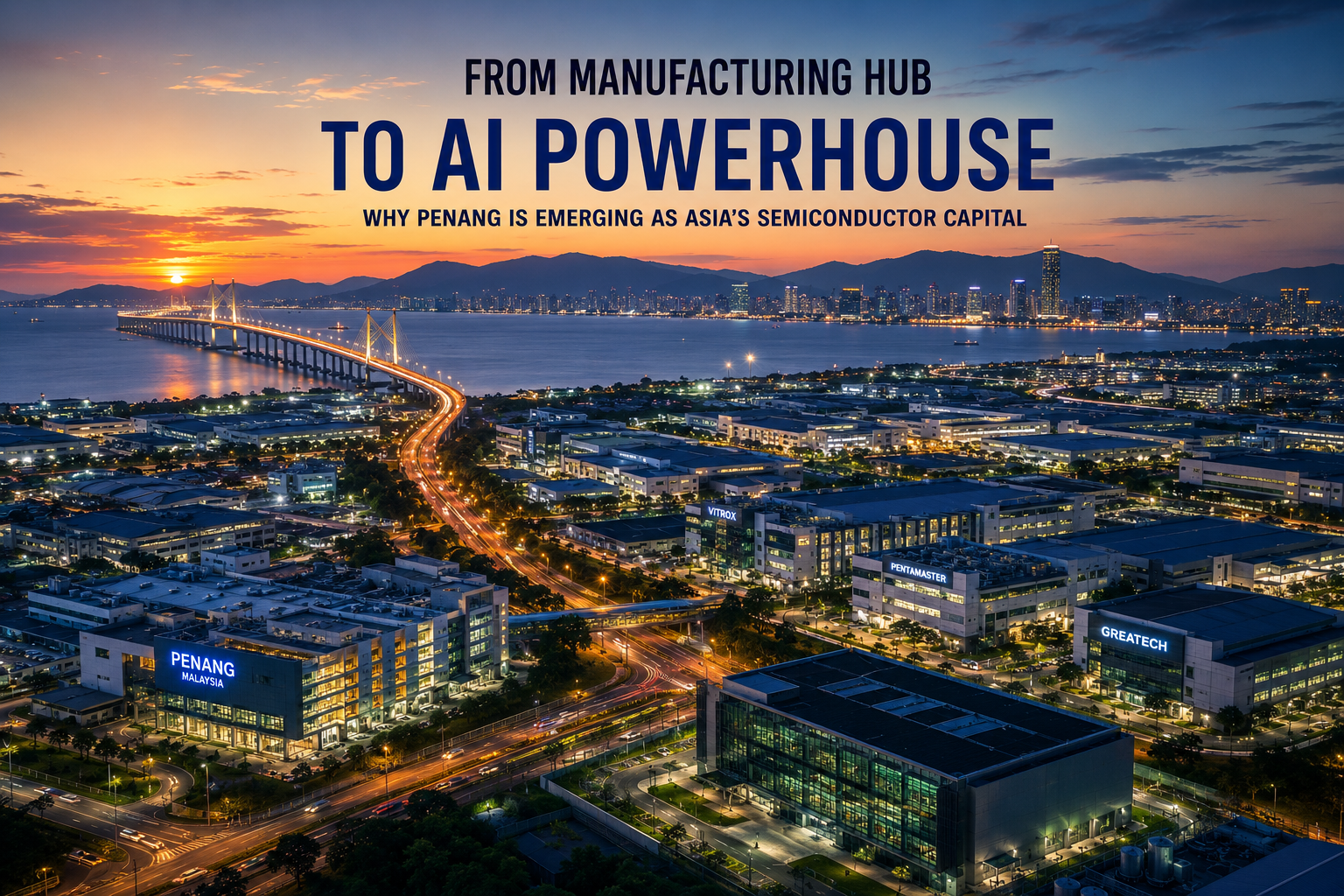
From Manufacturing Hub to AI Powerhouse: Why Penang Is Emerging as Asia’s Semiconductor Capital
By Ts. Lukas J. Tan
Founder of PDX2026 | CEO of OPERION | AI Educator & Digitalisation Strategist
Executive Summary
For more than five decades, Penang has quietly built one of the most important semiconductor ecosystems in Asia. What began as an electronics manufacturing destination has evolved into a globally connected industrial hub that plays a critical role in the production, assembly, testing, and automation of semiconductor technologies used around the world.
Today, however, a new chapter is unfolding.
The rise of Artificial Intelligence (AI), advanced computing, data centres, electric vehicles, and next-generation digital infrastructure is creating unprecedented demand for semiconductor technology. As nations compete to secure their positions within the global AI economy, Penang finds itself uniquely positioned to benefit from this transformation.
The state already possesses a mature manufacturing base, strong engineering capabilities, a dense industrial ecosystem, and growing support for semiconductor design and advanced technologies. More importantly, Penang has decades of accumulated expertise that cannot easily be replicated.
The future opportunity is no longer simply about manufacturing chips.
The future opportunity is about helping design, enable, and power the technologies that will define the AI era.
This article explores how Penang became a semiconductor leader, why AI is reshaping the global semiconductor landscape, what challenges remain, and how Penang can strengthen its position as one of Asia’s most strategic technology ecosystems.
Why Penang’s Semiconductor Story Matters More Than Ever
When discussing the future of Artificial Intelligence, most conversations focus on software.
People talk about:
- ChatGPT
- AI assistants
- Machine learning
- Generative AI
- Automation
Yet beneath every AI breakthrough lies a less visible reality.
AI requires semiconductors.
Every AI model.
Every data centre.
Every GPU.
Every cloud platform.
Every intelligent system.
All depend on semiconductor technology.
Without chips, AI does not exist.
This reality is creating renewed global attention on semiconductor ecosystems.
And few places in Southeast Asia possess a stronger semiconductor foundation than Penang.
The Making of a Semiconductor Ecosystem
Penang’s success did not happen overnight.
It is the result of decades of industrial development, policy consistency, talent cultivation, and ecosystem growth.
The journey began with foreign direct investment and electronics manufacturing.
During the early years, multinational corporations established production facilities focused primarily on assembly operations.
These investments created jobs and introduced technical capabilities into the local workforce.
Over time, however, the ecosystem evolved.
Companies expanded beyond assembly into:
- Testing
- Packaging
- Process engineering
- Automation
- Advanced manufacturing
As capabilities increased, supporting industries emerged.
Local suppliers developed.
Engineering talent expanded.
Knowledge transfer accelerated.
The result was the creation of a highly interconnected semiconductor ecosystem.
Today, Penang contributes approximately RM42 billion to GDP and supports more than 200,000 jobs through semiconductor-related activities.
These numbers reflect more than economic output.
They represent decades of accumulated expertise.
Understanding Penang’s Competitive Advantage
One of Penang’s greatest strengths lies in its position within the semiconductor value chain.
While much public attention focuses on wafer fabrication and advanced chip manufacturing, Penang has established global leadership in critical downstream activities.
These include:
OSAT (Outsourced Semiconductor Assembly and Test)
OSAT companies perform the packaging and testing functions required before chips can be integrated into final products.
Packaging is no longer a simple manufacturing activity.
In the AI era, advanced packaging has become one of the industry’s most strategic capabilities.
Modern AI chips require:
- High-speed communication
- Thermal management
- Compact integration
- Improved energy efficiency
Advanced packaging directly affects performance.
This makes Penang’s expertise increasingly valuable.
EMS (Electronics Manufacturing Services)
Penang also hosts a strong EMS ecosystem responsible for producing finished electronic products and systems.
Many products used globally today pass through Penang’s manufacturing ecosystem before reaching consumers.
This includes:
- Smartphones
- Medical devices
- Industrial systems
- Computing equipment
- Automotive electronics
The state’s position within these supply chains creates resilience and strategic relevance.
The Rise of Local Technology Champions
Another important development is the emergence of locally grown technology companies.
Historically, multinational corporations dominated industry discussions.
Today, Penang is increasingly recognised for nurturing homegrown innovation.
Companies such as:
- ViTrox
- Pentamaster
- Greatech
- TT Vision
have become important contributors to the semiconductor ecosystem.
These organisations specialise in:
- Automation systems
- Smart manufacturing
- Machine vision
- Inspection technologies
- Industrial equipment
Their growth demonstrates how Penang is moving beyond manufacturing toward technology creation and innovation.
Why AI Is Reshaping the Semiconductor Industry
Artificial Intelligence is creating the largest semiconductor demand cycle in modern history.
Training advanced AI models requires enormous computational resources.
Large language models consume:
- Thousands of GPUs
- Massive memory capacity
- Advanced networking infrastructure
- High-speed interconnects
As AI adoption accelerates globally, demand increases across the entire semiconductor ecosystem.
This includes:
- AI accelerators
- GPUs
- Memory chips
- Advanced packaging
- Networking hardware
As a result, semiconductor technology is no longer merely a manufacturing sector.
It is becoming a strategic national asset.
Countries increasingly view semiconductor capabilities as essential for economic competitiveness, digital sovereignty, and AI leadership.
Moving Upstream: The Shift Toward Design
Historically, Penang’s strength has been concentrated within manufacturing and back-end semiconductor activities.
The next phase of growth focuses on moving upstream.
This includes:
- Integrated Circuit (IC) Design
- AI Chip Design
- Semiconductor Research
- Product Development
- Intellectual Property Creation
At the national level, the Malaysian government has introduced the National Semiconductor Strategy (NSS).
The NSS aims to strengthen Malaysia’s position across the semiconductor value chain through significant investment and ecosystem development.
At the state level, initiatives such as Silicon Design @5km+ reflect Penang’s ambition to become a semiconductor design hub.
This evolution is strategically important.
Manufacturing creates value.
Design creates even greater value.
Future competitiveness depends on participating across both domains.
The Talent Challenge
Despite its strengths, Penang faces one major challenge.
Talent.
The semiconductor industry increasingly requires:
- Engineers
- Chip designers
- AI specialists
- Automation experts
- Data scientists
- System architects
Demand is growing faster than supply.
The AI boom is intensifying competition for highly skilled professionals.
Meanwhile, regional competitors continue to attract talent through:
- Higher salaries
- International opportunities
- Larger technology ecosystems
Singapore and Kuala Lumpur remain strong competitors in attracting specialised professionals.
Industry projections suggest that Penang may require tens of thousands of additional skilled workers over the coming years.
Addressing this challenge requires coordinated efforts involving:
- Universities
- Industry players
- Government agencies
- Technical institutions
Talent development is becoming as important as infrastructure development.
Why Penang Has an Opportunity Few Regions Possess
Many regions aspire to become technology hubs.
Few possess the industrial foundations required to achieve it.
Penang already has:
- Semiconductor manufacturing
- Global supply chain integration
- Engineering talent
- Industrial automation expertise
- Electronics ecosystem density
These assets create a powerful competitive advantage.
As AI reshapes global industries, regions with established semiconductor ecosystems are likely to benefit disproportionately.
The future winners may not be those who start building today.
They may be those who have spent decades preparing without realising it.
Penang is one of those regions.
Frequently Asked Questions
Why is Penang important to the semiconductor industry?
Penang hosts one of Asia’s most mature semiconductor ecosystems, including manufacturing, assembly, testing, packaging, automation, and engineering services.
What is OSAT?
OSAT stands for Outsourced Semiconductor Assembly and Test. These companies package and test semiconductor chips before they are integrated into final products.
Why is AI increasing semiconductor demand?
AI models require enormous computational power, driving demand for GPUs, memory chips, advanced packaging technologies, and data centre infrastructure.
What is Malaysia’s National Semiconductor Strategy?
The NSS is a national initiative designed to strengthen Malaysia’s semiconductor ecosystem through investment, talent development, and technology advancement.
Why is semiconductor talent becoming critical?
Future semiconductor growth increasingly depends on expertise in design, automation, AI, packaging, and advanced manufacturing technologies.
Conclusion: Penang’s Next Semiconductor Chapter
For decades, Penang helped manufacture technology for the world.
Today, the opportunity is far larger.
Artificial Intelligence is creating a new industrial revolution powered by semiconductors.
Every AI application depends on chips.
Every data centre depends on chips.
Every future digital economy depends on chips.
Penang already possesses many of the ingredients required to participate in this future.
The challenge now is not whether Penang can remain a manufacturing hub.
The challenge is whether Penang can evolve into a complete semiconductor and AI ecosystem encompassing manufacturing, design, talent, automation, and innovation.
If the past fifty years were about building semiconductor capacity, the next decade may be about shaping semiconductor leadership.
And in that future, Penang has the potential not only to make chips for the world, but to help design the technologies that power the world’s AI-driven future.
This is also why conversations surrounding AI readiness, semiconductor innovation, workforce transformation, and ecosystem collaboration are becoming increasingly important.
Because the future is no longer arriving.
It is already being built.