
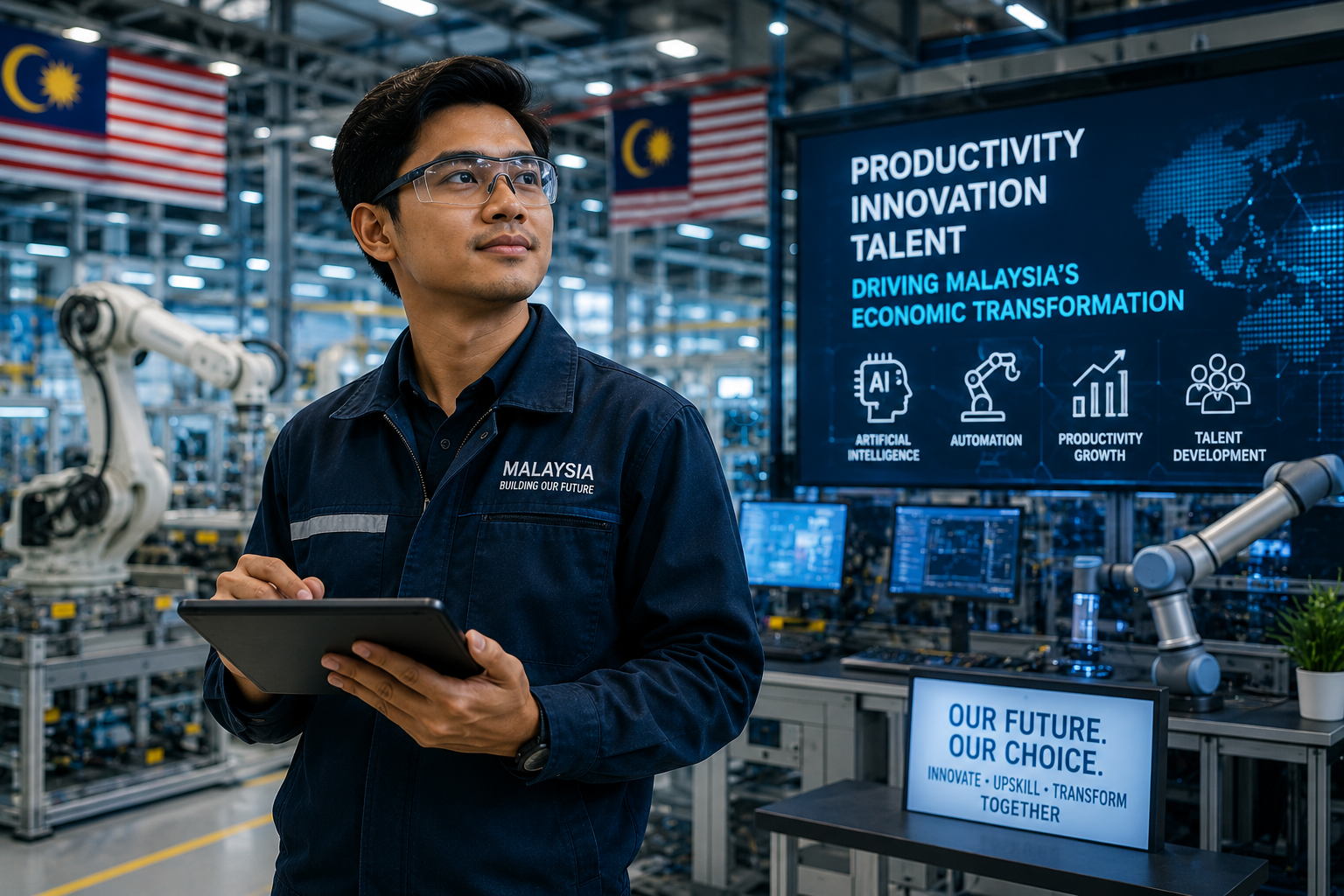
Malaysia’s Next Economic Transition: Why Productivity, AI and Talent Will Matter More Than Cheap Labour
By Ts. Lukas J. Tan
Founder of PDX2026 | CEO of OPERION | AI Educator & Digitalisation Strategist
Executive Summary
Malaysia is entering one of the most important economic transitions in its modern history.
For decades, many industries relied heavily on labour-intensive operating models. Manufacturing, construction, logistics, agriculture, retail, food services, and numerous other sectors grew rapidly because businesses could scale operations through workforce expansion. This model helped support economic growth, attract investment, and create employment opportunities across the country.
However, the global economy is changing.
Artificial Intelligence is transforming industries.
Automation is becoming more affordable.
Advanced manufacturing is expanding.
Productivity is becoming a competitive advantage.
Digital infrastructure is increasingly important.
At the same time, governments around the world are rethinking workforce strategies, talent development, and long-term economic competitiveness.
Malaysia is no exception.
The growing national discussion surrounding foreign labour dependency is not simply about reducing worker numbers. It is part of a much larger conversation about how Malaysia can transition from a cost-driven economy towards a productivity-driven economy.
The future may no longer belong to countries with the cheapest labour.
It may belong to countries that combine technology, talent, productivity, and innovation more effectively than their competitors.
Why Foreign Labour Has Become a National Conversation
Over the years, foreign workers have played an important role in Malaysia’s economic development.
Many industries depend on labour-intensive operations to maintain productivity, fulfil contracts, and support growth.
Construction projects require manpower.
Factories require operational staff.
Agricultural activities require field workers.
Logistics operations require workforce support.
Food service businesses require daily operational personnel.
Without these workers, many industries would struggle to operate at their current scale.
This reality explains why discussions about reducing foreign labour often trigger strong reactions from businesses and industry associations.
Many employers immediately ask a practical question.
If foreign labour is reduced, who will perform the work?
This concern is understandable.
Businesses are focused on operational continuity, labour costs, production capacity, and market competitiveness.
However, the broader policy objective extends beyond labour availability.
The real objective is economic transformation.
The Limitations of the Cheap Labour Model
For many years, low labour costs provided a competitive advantage.
Businesses could expand operations without significantly increasing investment in automation, digitalisation, or process optimisation.
Hiring additional workers was often faster and cheaper than redesigning operations.
While this approach supported growth, it also created several long-term challenges.
Productivity improvements slowed.
Technology adoption was delayed.
Operational inefficiencies became normal.
Workforce development received less attention.
Innovation investments were often postponed.
As global competition intensified, these weaknesses became increasingly visible.
Countries that invested aggressively in automation, advanced manufacturing, and workforce development began achieving higher productivity levels.
Meanwhile, economies that relied heavily on labour-cost advantages faced growing pressure.
Eventually, cost competitiveness alone became insufficient.
This is the challenge Malaysia is now attempting to address.
The Real Goal Is Productivity Growth
When policymakers discuss reducing dependency on foreign labour, the ultimate goal is not labour reduction itself.
The goal is productivity improvement.
Productivity measures how efficiently resources are converted into economic output.
Higher productivity allows businesses to:
Generate greater value.
Increase wages sustainably.
Improve competitiveness.
Expand profitability.
Support innovation.
Attract investment.
Countries with higher productivity generally enjoy stronger economic resilience and higher standards of living.
This explains why national conversations increasingly focus on:
Artificial Intelligence.
Automation.
Smart manufacturing.
Digitalisation.
Semiconductor development.
Advanced engineering.
Innovation ecosystems.
These initiatives are not isolated programmes.
They are components of a larger economic upgrading strategy.
Why AI Is Becoming a National Competitiveness Issue
Artificial Intelligence is rapidly becoming one of the most significant productivity tools available to businesses.
AI can assist organisations in:
Process automation.
Data analysis.
Customer service.
Operational optimisation.
Demand forecasting.
Quality control.
Predictive maintenance.
Decision support.
Unlike previous technology waves, AI has the potential to impact almost every industry simultaneously.
Manufacturers can optimise production.
Retailers can personalise customer experiences.
Logistics providers can improve route efficiency.
Healthcare organisations can enhance diagnostics.
Financial institutions can improve risk management.
As AI capabilities continue evolving, productivity gaps between organisations may widen significantly.
Businesses that adopt AI effectively may become substantially more competitive than those relying entirely on traditional operating models.
This is why AI is increasingly viewed not merely as a technology trend but as a strategic economic capability.
The Difference Between Low-Skilled Labour and High-Skilled Talent
One misunderstanding often appears in discussions about foreign labour.
Not all foreign workers contribute to the economy in the same way.
Broadly speaking, two distinct categories exist.
The first category involves labour-intensive operational roles.
These positions typically support industries requiring large workforces to maintain scale and continuity.
This is the area where policymakers hope automation, digitalisation, and productivity improvements can gradually reduce dependency.
The second category involves highly skilled professionals.
These include:
AI engineers.
Semiconductor specialists.
Cybersecurity experts.
Robotics consultants.
Advanced manufacturing engineers.
Data scientists.
Research professionals.
Technology architects.
In reality, many countries are actively competing to attract these individuals.
High-skilled talent often accelerates technology transfer, ecosystem development, innovation capability, and workforce maturity.
Rather than being viewed as a burden, they are often considered strategic assets.
This distinction is important because future economic competitiveness depends heavily on knowledge-intensive capabilities.
Why Economic Transitions Are Never Easy
Although the direction appears logical, implementation remains challenging.
Economic transitions rarely happen smoothly.
Businesses face genuine concerns.
Technology investments require capital.
Workforce retraining requires time.
Operational changes introduce uncertainty.
Small and medium-sized enterprises often face resource constraints.
Many business owners recognise the need for transformation but remain unsure where to begin.
Questions frequently arise.
Which technologies should be prioritised?
How much should be invested?
What returns can be expected?
How will employees adapt?
How long will the transition take?
These concerns explain why economic transformation requires more than policy announcements.
It requires ecosystem support.
Why SMEs Need More Than Technology
One of the biggest misconceptions about productivity transformation is the belief that technology alone solves the problem.
Technology is only part of the equation.
Successful transformation also requires:
Leadership alignment.
Workforce readiness.
Implementation capability.
Business process redesign.
Strategic planning.
Change management.
Many SMEs remain interested in automation and AI but struggle to translate concepts into action.
Some lack internal expertise.
Others fear making costly mistakes.
Many simply need a clearer roadmap.
Without guidance, technology adoption can become overwhelming.
This is why ecosystem support becomes increasingly important.
Businesses require access not only to solutions but also to practical implementation pathways.
The Rise of Malaysia’s Technology Ecosystems
The shift towards productivity-driven growth creates significant opportunities for Malaysia’s technology sector.
As industries modernise, demand is increasing for:
Automation providers.
AI solution developers.
ERP consultants.
Industrial software companies.
System integrators.
Smart manufacturing specialists.
Cybersecurity experts.
Digital transformation advisors.
Technology education providers.
This transformation has the potential to create entirely new growth sectors within the economy.
Particularly in regions such as Penang, where manufacturing expertise, engineering talent, semiconductor ecosystems, and technology exposure already exist, the opportunities are substantial.
The future economy may increasingly reward ecosystems capable of integrating manufacturing excellence with digital innovation.
Why Talent May Become Malaysia’s Most Valuable Resource
Technology alone cannot create competitiveness.
People remain the foundation of economic growth.
As automation increases, workforce requirements will evolve.
Future industries will require:
Problem-solving skills.
Digital literacy.
Technical expertise.
Engineering capabilities.
Adaptability.
Critical thinking.
Continuous learning.
This reality highlights the importance of workforce development.
TVET programmes.
Technical education.
Digital upskilling.
Professional certifications.
Industry collaboration.
Lifelong learning.
These initiatives will become increasingly important as Malaysia competes in a knowledge-intensive economy.
The future workforce will not simply operate machines.
It will manage systems, analyse information, solve complex problems, and collaborate with intelligent technologies.
Why Productivity Matters More Than Ever
Historically, many businesses competed primarily on cost.
In the future, competitiveness may depend more heavily on productivity.
The organisations that succeed will likely be those that can:
Produce more value with fewer resources.
Leverage technology intelligently.
Develop workforce capabilities.
Adapt to changing market conditions.
Scale operations efficiently.
Innovate continuously.
This shift changes the nature of competition.
Success becomes less dependent on labour volume and more dependent on operational effectiveness.
Productivity becomes a strategic advantage.
Frequently Asked Questions
Why is Malaysia discussing foreign labour dependency?
The broader objective is to improve national productivity, encourage technology adoption, strengthen workforce development, and support long-term economic competitiveness.
Will foreign workers disappear from Malaysia?
No. The discussion primarily focuses on reducing excessive dependence on low-skilled labour while continuing to attract highly skilled professionals who contribute to innovation and industrial development.
How does AI support productivity?
AI can automate repetitive tasks, improve decision-making, optimise operations, enhance forecasting accuracy, and increase organisational efficiency across multiple industries.
Why is talent important in a productivity-driven economy?
Technology requires skilled individuals to design, implement, manage, and improve systems. Future competitiveness depends heavily on workforce quality and adaptability.
What industries will benefit most from this transition?
Manufacturing, semiconductors, automation, logistics, engineering, digital services, AI solutions, cybersecurity, and advanced technology sectors are expected to benefit significantly.
Malaysia’s Next Chapter
Every successful economy eventually reaches a point where growth must evolve.
Malaysia appears to be approaching that moment.
The country can no longer rely exclusively on labour-cost advantages to compete globally.
Future competitiveness will increasingly depend on productivity, innovation, technology adoption, and workforce capability.
The transition will not be simple.
Businesses will face challenges.
Employees will need new skills.
Industries will require support.
Policymakers will continue balancing economic realities with long-term national objectives.
Yet within every transition lies opportunity.
Malaysia already possesses many important advantages.
A strong manufacturing base.
A growing semiconductor ecosystem.
Engineering talent.
Strategic regional positioning.
Expanding digital infrastructure.
Increasing technology investment.
The next challenge is ensuring these strengths evolve together.
Because the future economy will not belong solely to nations with the cheapest labour.
It will belong to ecosystems that can combine productivity, technology, talent, and strategic thinking more effectively than anyone else.
And in the age of AI, productivity may become the most important competitive advantage of all.